



| HEADLINE |

|
Traditional Tangail sarees strive to rebound amid market slowdown
Published : Friday, 13 March, 2026 at 12:00 AM
Md Sajjad Hossain Lincon


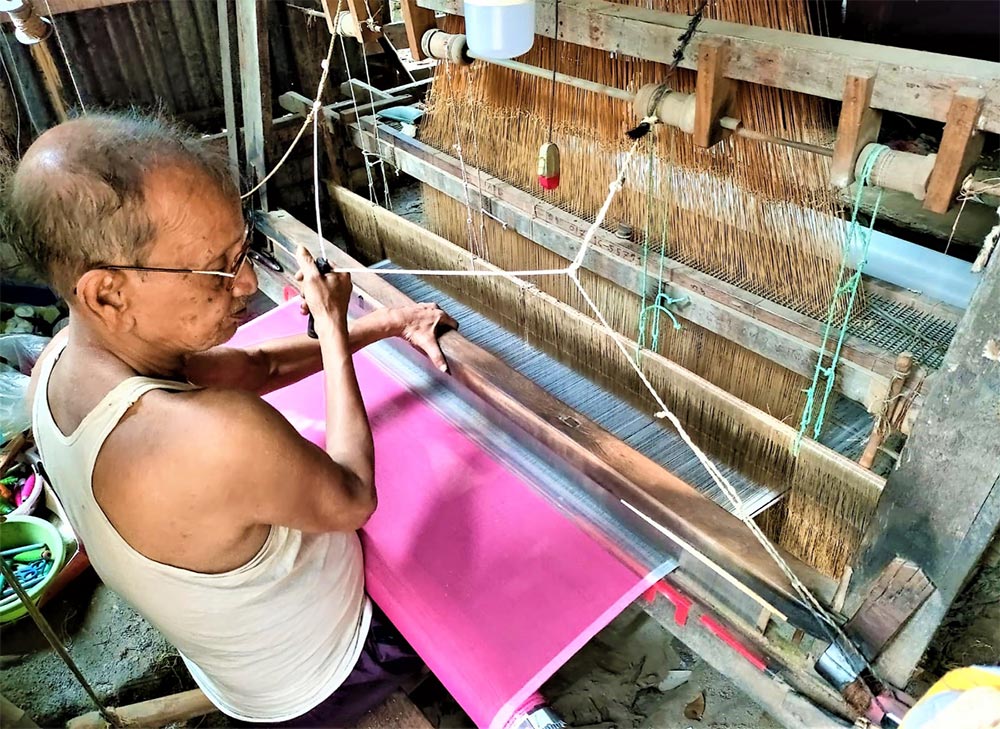
TANGAIL, Mar 12: The rhythmic 'khot-khot' of looms is back in Tangail, signalling a revival of hope for an industry that has weathered years of uncertainty, losses, and silence.
Tangail sarees, crafted by the Basak community since the late 19th century, are celebrated worldwide for their delicate silk, cotton, Jamdani, and soft silk fabrics. Known for lightweight comfort and intricate motifs-fish, lotus, and vine patterns adorning their borders-these sarees have been a timeless favourite among Bengali women. But despite international acclaim, the journey of Tangail sarees has not been smooth.
Early 2024 saw a controversy when West Bengal, India, claimed GI (Geographical Indication) rights over the sarees. Bangladesh swiftly secured official GI recognition for Tangail sarees on February 7, 2024. Further, in 2025, UNESCO honoured the 'Traditional Tangail Saree Weaving Industry' as an Intangible Cultural Heritage, reinforcing Bangladesh's exclusive ownership. Yet, recognition alone has not solved the struggles of local weavers.
Trade restrictions along the India-Bangladesh border have reduced exports, while rising costs of threads and dyes have squeezed profits. Many skilled artisans were forced to abandon their looms for other work, while low-cost power-loom sarees flooded the market, intensifying competition for traditional handloom products.
"The last few years were the hardest," says Rahmat Ali, a Pathrail weaver. "Debt, lack of orders, and rising costs forced many to leave weaving. Some became rickshaw drivers; others took odd jobs. But now, things are slowly improving."
Estimates indicate around 124,000 looms operate in Tangail District, supporting roughly 350,000 people. Although 40% of looms had closed during the slump, many are now coming back to life. Artisans are working tirelessly to produce Jamdani, silk, soft silk, and tissue silk sarees, with prices ranging from Tk 700 to Tk 20,000. During peak festivals, sarees priced between Tk 5,000 and Tk 22,000 see the highest demand. Online and offline markets alike are witnessing a surge in Tangail saree sales.
This year, the industry is targeting sales of 2.4 million sarees, worth approximately Tk 350 crore. Interestingly, the controversy over India's GI claim has boosted demand for Tangail sarees by 15-20% both domestically and internationally. However, many weaving units are now also producing three-piece suits and Punjabi fabrics, which are simpler to weave, require less labour, and yield higher returns.
At Pathrail's weaving clusters, the festive atmosphere is palpable. Artisans work day and night, their looms clattering tirelessly. "Last year, there was barely enough raw material. Orders were few, and we couldn't pay wages on time. This year, the owners are providing advances, so we can focus on weaving," says Dhiren Pal, a skilled craftsman.
Experts say that with reduced import duties on raw materials, easier loans, and proper market management, the Tangail saree industry could regain its lost glory. For now, the artisans are not just fighting for survival-they are weaving a dream: to restore the Tangail saree as a symbol of national pride and take it confidently to the global stage.
Loading...
Loading...
Also read



Editor : Iqbal Sobhan Chowdhury
Published by the Editor on behalf of the Observer Ltd. from Globe Printers, 24/A, New Eskaton Road, Ramna, Dhaka.
Editorial, News and Commercial Offices : Aziz Bhaban (2nd floor), 93, Motijheel C/A, Dhaka-1000.
Phone: PABX- 41053001-06; Advertisement: 41053012; 01793317829, 01550707291, E-mail: [email protected], [email protected] Online: email: [email protected] 41053014; 01550707297 Advertisement: 01550707296
Published by the Editor on behalf of the Observer Ltd. from Globe Printers, 24/A, New Eskaton Road, Ramna, Dhaka.
Editorial, News and Commercial Offices : Aziz Bhaban (2nd floor), 93, Motijheel C/A, Dhaka-1000.
Phone: PABX- 41053001-06; Advertisement: 41053012; 01793317829, 01550707291, E-mail: [email protected], [email protected] Online: email: [email protected] 41053014; 01550707297 Advertisement: 01550707296


