



| HEADLINE |

|

It is time Delhi and Kolkata drink from the same River



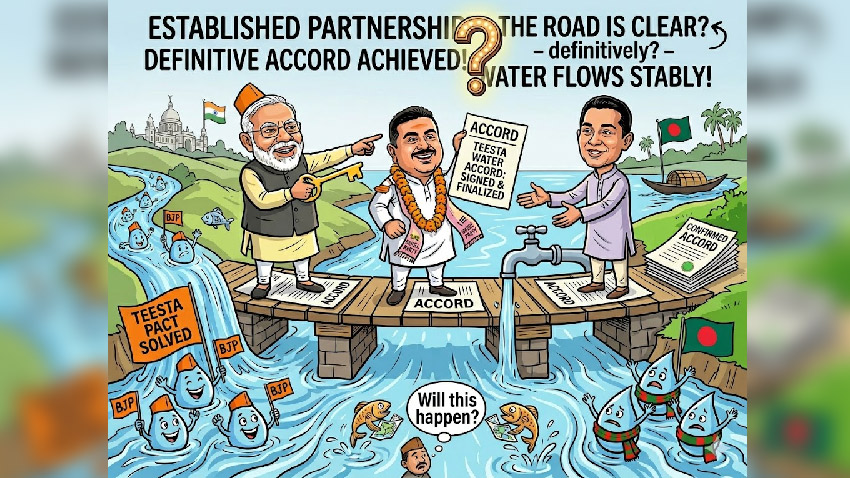
At times diplomacy resembles two neighbours arguing over the last bucket of water while simultaneously inviting each other for tea. The lingering unresolved Teesta River water-sharing dispute between India and Bangladesh has long embodied this peculiar mix of geography, politics, emotion, and irony. Yet, for the first time well over a decade, we now see emerging reasons to believe that the river may finally flow toward compromise rather than confrontation.
However, successive governments in Dhaka viewed the agreement as a test of goodwill from New Delhi, while India repeatedly found itself trapped between diplomatic commitments and domestic political restrictions. The near-breakthrough of 2011 under former Indian Prime Minister Manmohan Singh yet remains etched in our diplomatic memory like a missed train at Sealdah Station--painfully close to Dhaka, yet permanently delayed.
Nevertheless, Teesta evolved into far more than a hydrological dispute. It became a collision point of diplomacy, federalism, electoral politics, agriculture, regional identity and also national interest. Dhaka often viewed the delay as a question of political will in Delhi. Delhi, meanwhile, quietly pointed toward Kolkata. And Kolkata, naturally, pointed toward the concerns of farmers and local voters. Somewhere in between, the Teesta River kept flowing-- though not always diplomatically.
At the heart of the deadlock stood the ever defiant Mamata Banerjee by repeatedly blocking the proposed deal, understandably, her concerns were not entirely unreasonable. Northern West Bengal’s farmers depend heavily on Teesta waters for irrigation, and she argued that New Delhi had negotiated too hastily without adequately consulting the state government. In India’s federal structure, water is constitutionally a state subject, making any river-sharing arrangement far more complicated than a simple bilateral handshake between two national capitals.
But politics, like rivers, changes course. And recently concluded 2026 West Bengal Assembly election marked a dramatic political shift with Suvendu Adhikari-led Bharatiya Janata Party (BJP) winning a historic majority--over 200 of the 294 seats--defeating Mamata Banerjee and ending the All India Trinamool Congress (TMC)’s 15-year rule in the state.
Given this unprecedented and also unanticipated victory, a new BJP-led government in West Bengal undeniably introduces an entirely new dimension to the Teesta conversation. For the first time, the same political formation could potentially govern both New Delhi and Kolkata. The political alignment alone may remove one of the largest structural obstacles that stalled previous negotiations. What could not be achieved through coalition-era bargaining may now become politically manageable through coordinated governance.
Of course, optimism should neither be too high, nor too low. Even under a BJP-led state government, concerns over irrigation, agriculture, and water security in West Bengal will not magically disappear. Rivers obey hydrology, not party manifestos. Yet political synchronization between the Centre and the State can significantly ease consultation, negotiation, and implementation. We now eagerly await Delhi and Kolkata to speak the same political language while drinking from the same river-- the water now appears to be promisingly sweet.
This is precisely why the present moment feels different.
Equally significant is the appointment of Dinesh Trivedi as India’s new High Commissioner to Bangladesh. His appointment is rather unusual according to Indian diplomatic postings, but politically symbolic. Unlike traditional career diplomats, Trivedi brings deep political experience, strong roots in West Bengal, and familiarity with the emotional and strategic complexities surrounding Bangladesh.
That background may now prove invaluable and time befitting.
Sometimes diplomacy requires not only protocol and policy papers, but also political instinct, cultural familiarity, and the ability to read regional sensitivities. A diplomat can negotiate a document, but a politician-cum-diplomat can sometimes negotiate trust. Trivedi’s Bengal connections may allow him to bridge conversations that previously remained trapped between bureaucratic caution and political hesitation.
Indeed, New Delhi’s decision to send a senior political figure instead of a career diplomat signals that India understands the present moment as politically delicate but strategically important. Bangladesh is not merely another neighbouring country - it is India’s closest civilization partner in eastern South Asia. Geography alone guarantees interdependence. History deepens it while economics reinforces it.
Under the new Bangladesh government headed by Tarique Rahman, there also appears to be a fresh enthusiasm to reset ties with India after the turbulence that followed the dramatic collapse of Sheikh Hasina’s government on 5 August 2024. Recent diplomatic signals from both sides suggest a gradual thaw after a period marked mistrust, political rhetoric, and strategic uncertainty.
This changing atmosphere matters enormously.
To cut a long story short, India and Bangladesh have too much at stake to remain trapped in cycles of suspicion. Trade, connectivity, energy cooperation, border management, regional security, and cultural ties all suffer when political relations deteriorate. More importantly, ordinary people on both sides of the border understand something that politicians occasionally forget: Rivers do not recognize passports.
The Teesta dispute, therefore, should no longer be viewed impossible to resolve, it should instead be approached as an opportunity-- a chance to demonstrate that mature democracies can reconcile regional interests with broader diplomatic responsibilities.
South Asians often joke that our politicians can divide anything except election slogans. Yet the Teesta issue may finally prove the opposite: That even water can be shared when politics becomes cooperative rather than competitive.
A successful Teesta agreement would carry a significant value for both countries. For Bangladesh, it would represent long-awaited recognition of a critical national concern-- its fare share of water. For India, it would reaffirm credibility as a reliable regional partner honouring commitments despite domestic complexities. And for West Bengal, a balanced formula incorporating irrigation safeguards and seasonal flexibility could address agro anxieties while strengthening cross-border stability.
However, water-sharing agreements often generate broader confidence-building momentum. Once trust improves, cooperation expands naturally ranging from trade corridors, electricity grids to tourism, river transport, and to climate adaptation. In an age where climate change increasingly threatens South Asian water systems, collaborative river management is no longer a choice-- but an important precondition.
There is also a deeper political lesson here.
For years on end, critics have argued that India’s federal system itself made decisive regional diplomacy difficult. The Teesta deadlock became the textbook example to that testament. A future Teesta accord emerging through coordination between New Delhi and a politically aligned Kolkata government may therefore prove more stable than the abandoned 2011 framework.
The river, after all, has waited patiently.
History shows that India and Bangladesh usually move forward not when they focus on past grievances, but when they rediscover shared interests. The relationship has survived political transitions, border tensions, migration debates, and ideological shifts because the underlying realities of geography and culture remain stronger than temporary turbulence.
That is why this moment deserves cautious optimism.
The new BNP government in Bangladesh under Mr Tarique Rahman’s leadership offers an opening for resetting bilateral trust. Together, these factors create perhaps the most favourable conditions for progress since the failed 2011 agreement.
The Teesta dispute has lingered long enough to become a metaphor for missed opportunities. But let us not forget, rivers are also symbols of renewal.
And perhaps, after years of diplomatic drought, the waters of Teesta may finally begin to flow downstream again-- not toward division, but toward understanding.
However, successive governments in Dhaka viewed the agreement as a test of goodwill from New Delhi, while India repeatedly found itself trapped between diplomatic commitments and domestic political restrictions. The near-breakthrough of 2011 under former Indian Prime Minister Manmohan Singh yet remains etched in our diplomatic memory like a missed train at Sealdah Station--painfully close to Dhaka, yet permanently delayed.
Nevertheless, Teesta evolved into far more than a hydrological dispute. It became a collision point of diplomacy, federalism, electoral politics, agriculture, regional identity and also national interest. Dhaka often viewed the delay as a question of political will in Delhi. Delhi, meanwhile, quietly pointed toward Kolkata. And Kolkata, naturally, pointed toward the concerns of farmers and local voters. Somewhere in between, the Teesta River kept flowing-- though not always diplomatically.
At the heart of the deadlock stood the ever defiant Mamata Banerjee by repeatedly blocking the proposed deal, understandably, her concerns were not entirely unreasonable. Northern West Bengal’s farmers depend heavily on Teesta waters for irrigation, and she argued that New Delhi had negotiated too hastily without adequately consulting the state government. In India’s federal structure, water is constitutionally a state subject, making any river-sharing arrangement far more complicated than a simple bilateral handshake between two national capitals.
But politics, like rivers, changes course. And recently concluded 2026 West Bengal Assembly election marked a dramatic political shift with Suvendu Adhikari-led Bharatiya Janata Party (BJP) winning a historic majority--over 200 of the 294 seats--defeating Mamata Banerjee and ending the All India Trinamool Congress (TMC)’s 15-year rule in the state.
Given this unprecedented and also unanticipated victory, a new BJP-led government in West Bengal undeniably introduces an entirely new dimension to the Teesta conversation. For the first time, the same political formation could potentially govern both New Delhi and Kolkata. The political alignment alone may remove one of the largest structural obstacles that stalled previous negotiations. What could not be achieved through coalition-era bargaining may now become politically manageable through coordinated governance.
Of course, optimism should neither be too high, nor too low. Even under a BJP-led state government, concerns over irrigation, agriculture, and water security in West Bengal will not magically disappear. Rivers obey hydrology, not party manifestos. Yet political synchronization between the Centre and the State can significantly ease consultation, negotiation, and implementation. We now eagerly await Delhi and Kolkata to speak the same political language while drinking from the same river-- the water now appears to be promisingly sweet.
This is precisely why the present moment feels different.
Equally significant is the appointment of Dinesh Trivedi as India’s new High Commissioner to Bangladesh. His appointment is rather unusual according to Indian diplomatic postings, but politically symbolic. Unlike traditional career diplomats, Trivedi brings deep political experience, strong roots in West Bengal, and familiarity with the emotional and strategic complexities surrounding Bangladesh.
That background may now prove invaluable and time befitting.
Sometimes diplomacy requires not only protocol and policy papers, but also political instinct, cultural familiarity, and the ability to read regional sensitivities. A diplomat can negotiate a document, but a politician-cum-diplomat can sometimes negotiate trust. Trivedi’s Bengal connections may allow him to bridge conversations that previously remained trapped between bureaucratic caution and political hesitation.
Indeed, New Delhi’s decision to send a senior political figure instead of a career diplomat signals that India understands the present moment as politically delicate but strategically important. Bangladesh is not merely another neighbouring country - it is India’s closest civilization partner in eastern South Asia. Geography alone guarantees interdependence. History deepens it while economics reinforces it.
Under the new Bangladesh government headed by Tarique Rahman, there also appears to be a fresh enthusiasm to reset ties with India after the turbulence that followed the dramatic collapse of Sheikh Hasina’s government on 5 August 2024. Recent diplomatic signals from both sides suggest a gradual thaw after a period marked mistrust, political rhetoric, and strategic uncertainty.
This changing atmosphere matters enormously.
To cut a long story short, India and Bangladesh have too much at stake to remain trapped in cycles of suspicion. Trade, connectivity, energy cooperation, border management, regional security, and cultural ties all suffer when political relations deteriorate. More importantly, ordinary people on both sides of the border understand something that politicians occasionally forget: Rivers do not recognize passports.
The Teesta dispute, therefore, should no longer be viewed impossible to resolve, it should instead be approached as an opportunity-- a chance to demonstrate that mature democracies can reconcile regional interests with broader diplomatic responsibilities.
South Asians often joke that our politicians can divide anything except election slogans. Yet the Teesta issue may finally prove the opposite: That even water can be shared when politics becomes cooperative rather than competitive.
A successful Teesta agreement would carry a significant value for both countries. For Bangladesh, it would represent long-awaited recognition of a critical national concern-- its fare share of water. For India, it would reaffirm credibility as a reliable regional partner honouring commitments despite domestic complexities. And for West Bengal, a balanced formula incorporating irrigation safeguards and seasonal flexibility could address agro anxieties while strengthening cross-border stability.
However, water-sharing agreements often generate broader confidence-building momentum. Once trust improves, cooperation expands naturally ranging from trade corridors, electricity grids to tourism, river transport, and to climate adaptation. In an age where climate change increasingly threatens South Asian water systems, collaborative river management is no longer a choice-- but an important precondition.
There is also a deeper political lesson here.
For years on end, critics have argued that India’s federal system itself made decisive regional diplomacy difficult. The Teesta deadlock became the textbook example to that testament. A future Teesta accord emerging through coordination between New Delhi and a politically aligned Kolkata government may therefore prove more stable than the abandoned 2011 framework.
The river, after all, has waited patiently.
History shows that India and Bangladesh usually move forward not when they focus on past grievances, but when they rediscover shared interests. The relationship has survived political transitions, border tensions, migration debates, and ideological shifts because the underlying realities of geography and culture remain stronger than temporary turbulence.
That is why this moment deserves cautious optimism.
The new BNP government in Bangladesh under Mr Tarique Rahman’s leadership offers an opening for resetting bilateral trust. Together, these factors create perhaps the most favourable conditions for progress since the failed 2011 agreement.
The Teesta dispute has lingered long enough to become a metaphor for missed opportunities. But let us not forget, rivers are also symbols of renewal.
And perhaps, after years of diplomatic drought, the waters of Teesta may finally begin to flow downstream again-- not toward division, but toward understanding.

The writer is Editorial Chief, The Daily Observer

Loading...
Loading...
Also read









Editor : Iqbal Sobhan Chowdhury
Published by the Editor on behalf of the Observer Ltd. from Globe Printers, 24/A, New Eskaton Road, Ramna, Dhaka.
Editorial, News and Commercial Offices : Aziz Bhaban (2nd floor), 93, Motijheel C/A, Dhaka-1000.
Phone: PABX- 41053001-06; Advertisement: 41053012; 01793317829, 01550707291, E-mail: [email protected], [email protected] Online: email: [email protected] 41053014; 01550707297 Advertisement: 01550707296
Published by the Editor on behalf of the Observer Ltd. from Globe Printers, 24/A, New Eskaton Road, Ramna, Dhaka.
Editorial, News and Commercial Offices : Aziz Bhaban (2nd floor), 93, Motijheel C/A, Dhaka-1000.
Phone: PABX- 41053001-06; Advertisement: 41053012; 01793317829, 01550707291, E-mail: [email protected], [email protected] Online: email: [email protected] 41053014; 01550707297 Advertisement: 01550707296


