



| HEADLINE |

|
GI recognition of Faridpur jute opens new export horizons
Published : Wednesday, 13 May, 2026 at 12:00 AM
Dr Md Al-Mamun


 Bangladesh's jute and jute products sector has been playing an important role in the country's economy, rural livelihoods and environmentally friendly development for many decades. Once known as the 'golden fiber', this crop was the country's main source of foreign exchange earnings. The driving force of the rural economy, the development of industrial areas and one of the carriers of the country's identity in the international arena - jute was the centerpiece in all areas. Jute from the Faridpur region in particular had earned a distinct reputation in the global market due to its long, bright and strong fibers.
Currently, the demand for renewable and environmentally friendly raw materials is increasing due to plastic pollution, climate change and environmental crises around the world. In this context, the Geographical Indication (GI) recognition of Faridpur jute is being considered an important milestone for Bangladesh. GI recognition is not just an administrative achievement; It is a tool for internationally recognizing the origin, quality characteristics and heritage of a product.
Faridpur has a long history of jute. Due to the fertile alluvial soil of the Padma, Arial Khan and other riverine areas, favorable climate and centuries-old farming methods, the jute fibers here are comparatively long, smooth and strong. From the British period to the Pakistan period, this jute, known as 'Faridpur jute' in the international market, was in great demand in European industries. At that time, Bengali jute was a symbol of quality raw materials. And Faridpur jute was the best example of that.
In the 2024-25 season, jute was cultivated on about 7 lakh hectares of land in Bangladesh and an estimated 1.6 lakh metric tons of jute fiber was produced. Of this, more than 2 lakh metric tons were produced on about 86,500 hectares of land in Faridpur district. These statistics reflect the agricultural potential and jute tradition of the region.
What was once the 'golden thread' is, as it were, disconnected from the mainstream of the economy. However, the global reality is now changing. The demand for eco-friendly raw materials is increasing worldwide to address plastic pollution, climate change and environmental crises. The developed world, including the European Union, is looking for alternatives to plastic. In this context, jute has once again emerged as a promising natural fiber. The GI recognition of Faridpur jute is a strategic opportunity for Bangladesh in this changing global context. One of the major benefits of GI recognition is branding and market protection. It gives a unique identity to the jute of the Faridpur region, which increases its acceptance in the international market. At the same time, farmers will get a fair price and the influence of middlemen will be reduced. However, these benefits will not come automatically. Well-planned policies, effective implementation and coordinated initiatives are needed to convert GI recognition into economic success.
Advances in research and technology are important in this regard. The Bangladesh Jute Research Institute has made significant progress in jute research in the last decade. Bangladesh created history by becoming the first country in the world by developing high-yielding varieties, developing disease-resistant and climate-tolerant jute and discovering the genome sequence of jute in 2010. This scientific achievement has opened the door to new possibilities in the jute industry. Currently, research is underway on low-lignin jute, environmentally friendly grading technology and modern processing methods, which can diversify the quality and uses of jute.
The nutritional value and medicinal potential of jute leaves are also gaining new importance. Jute leaves, rich in iron, calcium and antioxidants, can create new possibilities in the food and health product industry. If these broad areas of research are combined with industrialization, jute can be transformed into not only a raw material, but also a multi-dimensional economic asset. Currently, the demand for versatile jute products is increasing rapidly in the global market. The use of jute is increasing in the jute geotextile, biodegradable packaging, jute composite, furniture board, home decor, fashion items, and even the automobile industry. Especially in the geotextile sector, the use of jute has proven to be an environmentally friendly alternative in soil erosion control, riverbank conservation and road construction. Domestically, the initiative to use jute geotextiles in the Roads and Highways Department, Bangladesh Railways, and Water Development Board indicates positive progress.
Bangladesh is currently the world's second largest jute producer and the top exporter of jute and jute products. Yet, the jute sector contributes only about 2 percent to the country's total export earnings. The main reasons for this are high tariff and non-tariff barriers in the international market, strict standards and certification complexities, technological backwardness, and lack of a coordinated support system for entrepreneurs. Small and medium entrepreneurs in particular are unable to survive in the global market due to their failure to comply with international standards.
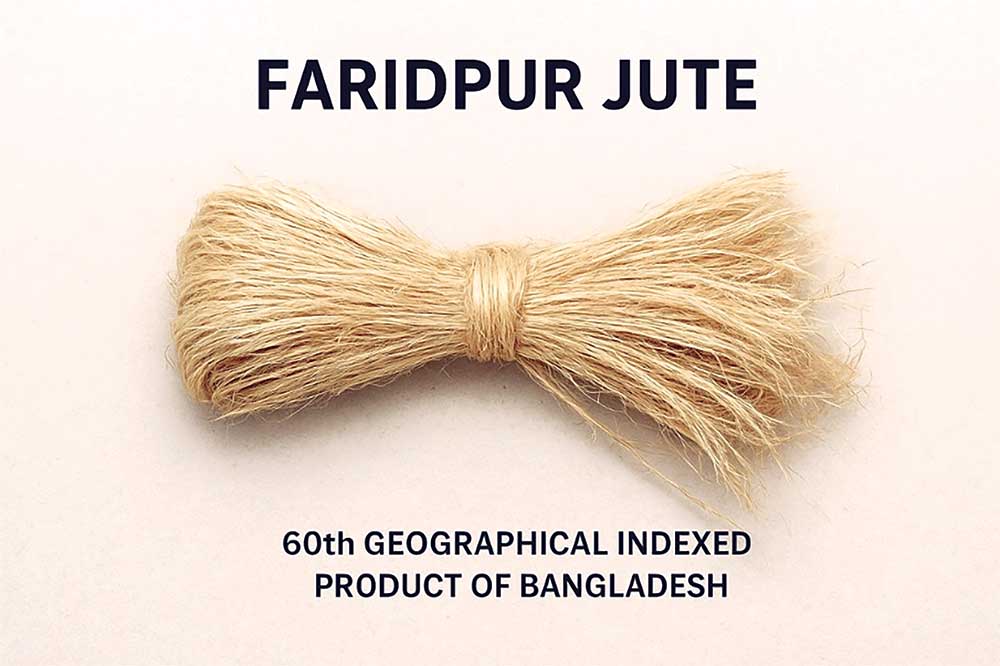
The GI recognition of Faridpur jute is not just a reminder of past glory; it is the foundation of a promising future green economy. If appropriate policies, science-based research, an entrepreneur-friendly environment and fair rights of farmers are ensured, the 'golden fiber' can once again return to the center of Bangladesh's economic identity. The time has come to transform this potential into an effective reality, otherwise we will fall behind in the global green market.
If statistics, research and policy initiatives are used in a coordinated manner, Faridpur jute can be re-established as a carrier of Bangladesh's green revolution. This dual responsibility lies before us of preserving tradition and integrating it with the modern economy. If the right policies, industry-research linkages and entrepreneurial development are ensured, the jute sector will become one of the main green economic drivers of the country in the coming days.
The writer is a Principal Scientific Officer at Bangladesh Jute Research Institute (BJRI)
Loading...
Loading...
Also read



Editor : Iqbal Sobhan Chowdhury
Published by the Editor on behalf of the Observer Ltd. from Globe Printers, 24/A, New Eskaton Road, Ramna, Dhaka.
Editorial, News and Commercial Offices : Aziz Bhaban (2nd floor), 93, Motijheel C/A, Dhaka-1000.
Phone: PABX- 41053001-06; Advertisement: 41053012; 01793317829, 01550707291, E-mail: [email protected], [email protected] Online: email: [email protected] 41053014; 01550707297 Advertisement: 01550707296
Published by the Editor on behalf of the Observer Ltd. from Globe Printers, 24/A, New Eskaton Road, Ramna, Dhaka.
Editorial, News and Commercial Offices : Aziz Bhaban (2nd floor), 93, Motijheel C/A, Dhaka-1000.
Phone: PABX- 41053001-06; Advertisement: 41053012; 01793317829, 01550707291, E-mail: [email protected], [email protected] Online: email: [email protected] 41053014; 01550707297 Advertisement: 01550707296


