



| HEADLINE |

|
Salinity-hit fields turn golden as sunflowers bloom
Published : Monday, 1 June, 2026 at 12:00 AM
Our Correspondent


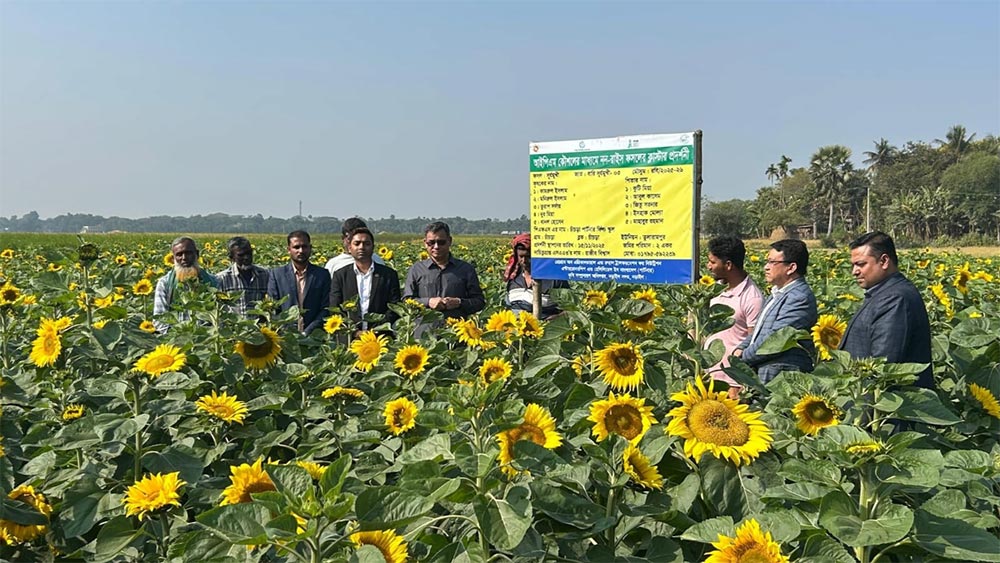 DUMURIA, KHULNA, May 31: Bright yellow sunflower fields are transforming saline, fallow land in Dumuria, where farmers are reporting strong yields under a government-backed push to expand oilseed production.
The crop is being promoted as part of Bangladesh's efforts to reduce heavy dependence on imported edible oil, which costs the country large sums of foreign currency every year.
Agriculture officials say sunflower cultivation is expanding across the coastal belt under the "Programme on Agricultural and Rural Transformation for Nutrition, Entrepreneurship and Resilience in Bangladesh (PARTNER)" project. Farmers are being provided with seeds, fertilisers, pesticides and technical training to bring unused saline land under cultivation.
The initiative is focused on the south-western coastal region, including Khulna, Satkhira, Narail and Bagerhat, where soil salinity affects more than half of the farmland. Much of this land remains unused after the Aman paddy harvest.
Officials estimate that around 2.5 lakh hectares of land typically stay fallow during the post-harvest season, creating an opportunity for short-duration crops like sunflower.
The crop is gaining popularity due to its ability to withstand high salinity levels. It also requires relatively low irrigation and has a short growth cycle of about 85-105 days, allowing farmers to fit it between rice seasons.
"Earlier, these lands would remain idle after Aman harvest. Now farmers are showing interest after seeing demonstration plots," said Arif Hossain, agriculture officer of Phultala Upazila.
Farmers say the results have been encouraging.
"I tried sunflower for the first time this season. I never thought such land could produce this much," said Kamrul Islam, a farmer from a local village. "The yield has surprised me."
Across demonstration plots, large stretches of blooming sunflowers are now visible, forming bright yellow carpets across what were once unused saline fields. Farmers say the crop is not only profitable but also helping revive unused land and boost rural incomes.
Agriculture officials say the cost of cultivation remains relatively low compared to other crops, while returns are significantly higher in many cases. They add that sunflower farming also improves soil health, making land more productive for subsequent crops.
The PARTNER project's regional monitoring officer Md Mosaddek Hossain said the initiative could help reduce import dependence if expanded further.
"Only a small portion of edible oil demand is met locally. Increasing sunflower production can reduce pressure on imports," he said.
He added that expanding cultivation on fallow saline land could play a key role in strengthening Bangladesh's edible oil supply chain while improving livelihoods in climate-vulnerable coastal areas.
Loading...
Loading...
Also read



Editor : Iqbal Sobhan Chowdhury
Published by the Editor on behalf of the Observer Ltd. from Globe Printers, 24/A, New Eskaton Road, Ramna, Dhaka.
Editorial, News and Commercial Offices : Aziz Bhaban (2nd floor), 93, Motijheel C/A, Dhaka-1000.
Phone: PABX- 41053001-06; Advertisement: 41053012; 01793317829, 01550707291, E-mail: [email protected], [email protected] Online: email: [email protected] 41053014; 01550707297 Advertisement: 01550707296
Published by the Editor on behalf of the Observer Ltd. from Globe Printers, 24/A, New Eskaton Road, Ramna, Dhaka.
Editorial, News and Commercial Offices : Aziz Bhaban (2nd floor), 93, Motijheel C/A, Dhaka-1000.
Phone: PABX- 41053001-06; Advertisement: 41053012; 01793317829, 01550707291, E-mail: [email protected], [email protected] Online: email: [email protected] 41053014; 01550707297 Advertisement: 01550707296


