



| HEADLINE |

|
A Budget to Bridge the Divide
Tax Overhaul, Social Spending Surge Signal Bold Assault on Inequality
Published : Friday, 12 June, 2026 at 12:00 AM
Faruk Ahmed


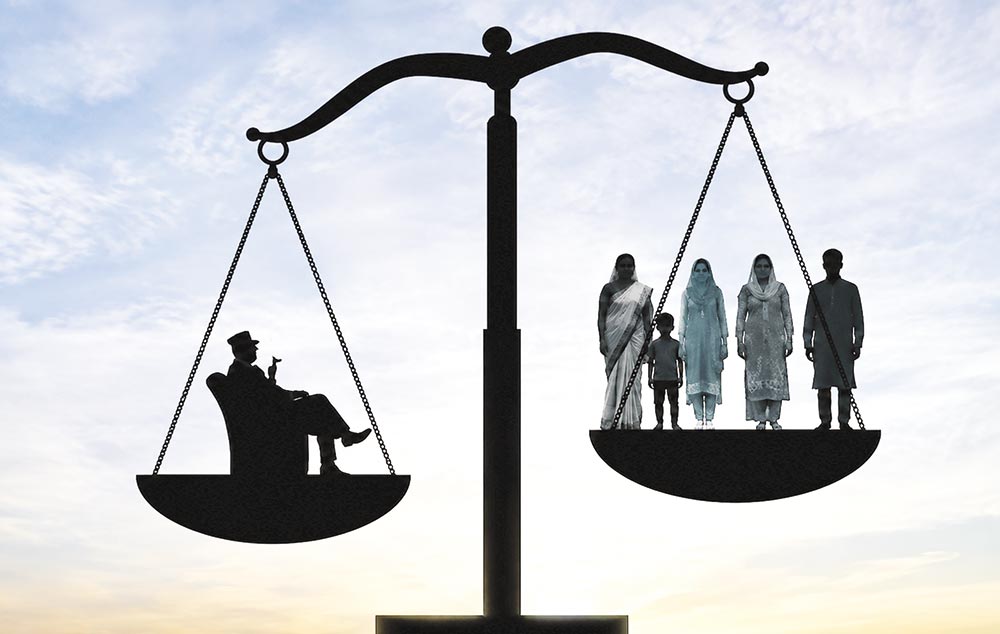 Finance Minister Amir Khasru Mahmud Chowdhury on Thursday unveiled an ambitious package of sweeping tax reforms, expanded social investment and financial inclusion measures in the national budget for FY2026-27, placing the fight against wealth inequality at the heart of the government’s economic agenda.
Presenting a Tk 9.38 lakh crore budget in the Jatiya Sangsad, the Finance Minister described the fiscal plan as a roadmap for an “inclusive economic transformation” aimed at ensuring that the gains from growth are more evenly shared across society, rather than concentrated in a narrow elite.
A key relief measure in the budget is the proposal to raise the tax-free income threshold for individual taxpayers to Tk 375,000 from Tk 350,000, offering modest but meaningful support to lower-income earners and sections of the middle class struggling under persistent inflationary pressure.
In a significant intervention on the cost of living, the government has also proposed reducing source tax on nearly 60 essential commodities-including rice, wheat, potatoes, fish, poultry and edible oil-to a uniform 0.5 per cent. Economists say the move could help stabilise food prices and ease pressure on households that spend a large share of their income on basic consumption.
The budget further strengthens the social protection architecture through expanded targeted welfare programmes, including family support cards and enhanced assistance for farmers, fishers and livestock producers. The government says these measures are designed to improve income security in rural areas and reduce entrenched regional disparities.
At the core of the fiscal strategy is a far-reaching overhaul of the tax system aimed at improving revenue mobilisation, curbing evasion and restoring fairness in the distribution of the tax burden. The plan includes separating tax policy from tax administration, modernising revenue governance and accelerating full automation of tax processes.
“We are restructuring the revenue system and modernising tax administration to increase domestic resource mobilisation and restore public confidence,” the minister told the House.
Under the medium-term fiscal framework, the government aims to lift the tax-to-GDP ratio from 6.8 per cent to 9.6 per cent by FY2030-31, while raising the revenue-to-GDP ratio from 8 per cent to 11 per cent.
Economists argue that stronger revenue performance is essential for reducing inequality, enabling the state to expand investment in education, healthcare, social protection and job creation.
In a major redistribution-oriented move, Tk 2.79 lakh crore-nearly 30 per cent of total expenditure-has been allocated to social infrastructure, with education, health and safety net programmes receiving priority funding.
A standout feature of the budget is a dramatic expansion in education spending, which has been raised to Tk 1.36 lakh crore from Tk 87,206 crore in the current fiscal year. The package includes expanded free undergraduate education for female students and enhanced support for disadvantaged learners.
The government also underscored financial inclusion as a central pillar of its inequality-reduction strategy, expanding access to formal finance for women, young entrepreneurs and marginalised groups, while supporting SMEs, IT ventures and modern agriculture-based enterprises.
Additional incentives for youth entrepreneurship, vocational training and female labour force participation are expected to strengthen upward mobility and broaden income opportunities.
Policy emphasis has also been placed on strengthening the banking sector, improving governance, and recovering defaulted loans to reduce the concentration of economic power. Authorities believe a more disciplined financial system will help ensure fairer access to credit and capital.
The budget further expands compliance measures through wider use of Taxpayer Identification Numbers (TINs) and Business Identification Numbers (BINs), alongside higher taxation on tobacco and selected non-essential goods. Incentives for green industries and electric vehicles have also been introduced, aligning revenue mobilisation with environmental goals.
Higher allocations for agriculture, SMEs, infrastructure, the blue economy and creative industries are expected to support employment generation and diversify growth drivers.
Policy analysts welcomed the budget’s strong redistribution narrative but cautioned that its success would depend heavily on implementation, particularly in enforcing tax compliance among high-income earners and tackling evasion.
They also stressed that meaningful inequality reduction would require deeper structural reforms, including more effective taxation of wealth and property, alongside sustained investment in public services.
While the FY2026-27 budget signals a decisive shift towards a more redistribution-focused development model, its long-term impact will ultimately hinge on execution capacity and the state’s ability to translate higher revenues into tangible gains for the country’s poorest citizens.
Loading...
Loading...
Also read



Editor : Iqbal Sobhan Chowdhury
Published by the Editor on behalf of the Observer Ltd. from Globe Printers, 24/A, New Eskaton Road, Ramna, Dhaka.
Editorial, News and Commercial Offices : Aziz Bhaban (2nd floor), 93, Motijheel C/A, Dhaka-1000.
Phone: PABX- 41053001-06; Advertisement: 41053012; 01793317829, 01550707291, E-mail: [email protected], [email protected] Online: email: [email protected] 41053014; 01550707297 Advertisement: 01550707296
Published by the Editor on behalf of the Observer Ltd. from Globe Printers, 24/A, New Eskaton Road, Ramna, Dhaka.
Editorial, News and Commercial Offices : Aziz Bhaban (2nd floor), 93, Motijheel C/A, Dhaka-1000.
Phone: PABX- 41053001-06; Advertisement: 41053012; 01793317829, 01550707291, E-mail: [email protected], [email protected] Online: email: [email protected] 41053014; 01550707297 Advertisement: 01550707296


