



| HEADLINE |

|
Illegal nets threaten Chalan Beel's monsoon fish bounty


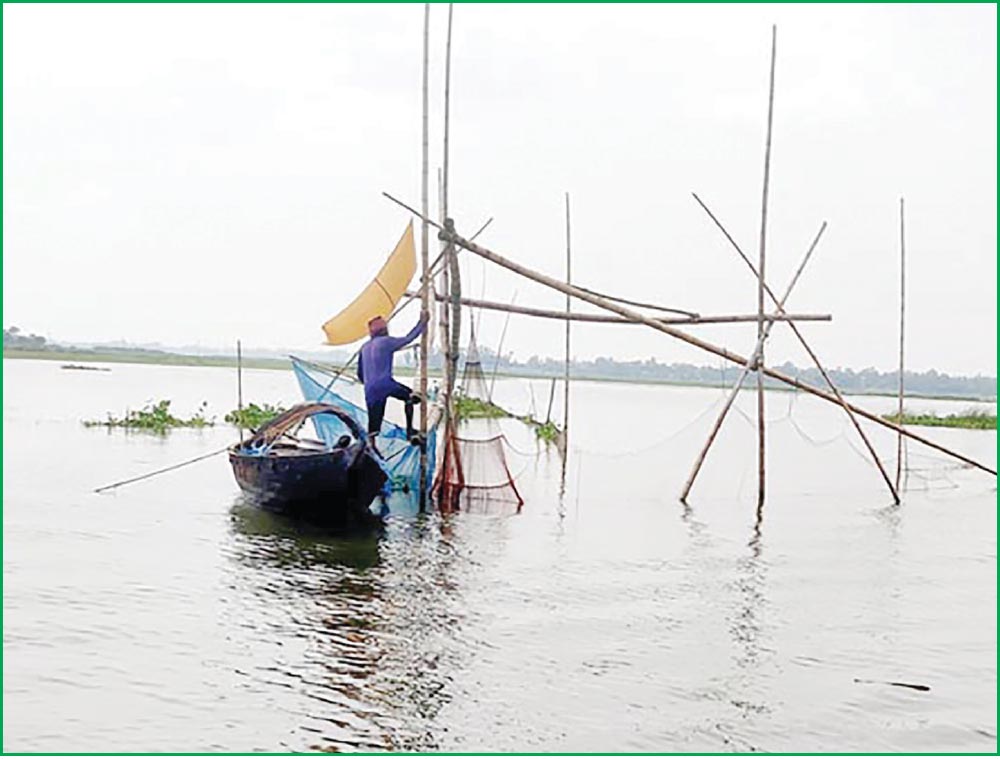 GURUDASPUR, NATORE, July 16: Native fish have returned in abundance to Chalan Beel following days of heavy rainfall and inflows from upstream, bringing relief to fishing communities across the country's largest wetland. But conservationists and locals warn that the widespread use of banned fine-mesh "China duari" nets is threatening the long-term sustainability of the fishery.
The seasonal influx of freshwater has boosted fish populations across the vast wetland spanning parts of Natore, Sirajganj and Pabna districts. Fish markets in Gurudaspur, Singra, Tarash, Chatmohar and Bhangura have become busy from dawn as fishermen land large quantities of indigenous fish.
However, locals say the resurgence is being undermined by the indiscriminate use of banned nets that catch not only juvenile fish but also brood fish carrying eggs, along with crabs, swamp eels, snails, mussels and other aquatic species.
They alleged that although these small fish and aquatic animals are openly sold in local markets, enforcement against the illegal practice remains inadequate.
Fishermen said the rising water levels have reconnected rivers, canals and beels, allowing fish to move freely and significantly increasing catches over the past few days.
Species such as tengra, punti, koi, shing, magur, guchi, chanda, shoal and boal are now being caught in large numbers, providing much-needed income for fishing families after a prolonged lean period.
Visits to fish markets in Singra Bus Stand, Chachkoir, Dahia, Bildahar, Satpukuria, Biyash, Jamtali, Tarash, Chatmohar and Bhangura found hundreds of professional and seasonal fishermen selling indigenous fish each morning.
Afzal Hossain, a fisherman from Bilsha Village, said catches had increased significantly with the arrival of fresh monsoon water.
"More fish are being caught now than before, but many juvenile and egg-bearing fish are also ending up in the nets, which is worrying for the future," he said.
Several fishermen, speaking on condition of anonymity, said the use of banned China duari nets had increased sharply across Chalan Beel.
"These nets trap fish of all sizes, including fry and brood fish. Many are later sold in local markets. The authorities need to strengthen monitoring and enforcement," one fisherman said.
Despite the increased supply, retail prices have remained relatively high.
Rabbiul Karim, a college teacher and customer at Chachkoir market, said, "The supply of native fish has increased, but prices have not fallen much. Still, people buy them because freshly caught monsoon fish have a unique taste."
At local markets, medium-sized freshwater prawns were selling for around Tk 800 per kg, small guchi fish for Tk 600, medium guchi for Tk 800, tengra for Tk 300-400, small punti for Tk 100, medium punti for Tk 200, koi for Tk 200-300, chanda for Tk 200, shoal for Tk 400-600 and medium-sized boal for Tk 500-800 per kg.
The increased supply has also led to the emergence of temporary wholesale fish markets in several locations, including Kundoil and Mannannagar in Tarash, Dahia Bridge, Paril Bridge and Biyash Mabia intersection, where fish worth several hundred thousand taka are traded daily before being transported to Dhaka and other parts of the country.
Mizanur Rahman Majnu, Convener of the Chalan Beel River and Environment Protection Committee, said the seasonal abundance of indigenous fish was encouraging but warned that illegal fishing practices could reverse the gains.
"The unrestricted use of banned China duari nets is destroying the breeding potential of native fish by indiscriminately catching fry and egg-bearing fish. Effective enforcement, regular drives and greater public awareness are essential to protect Chalan Beel's biodiversity and ensure sustainable fisheries," he said.
Local conservationists echoed the call, urging authorities to intensify operations against banned nets, prevent the harvesting of juvenile and brood fish, and strengthen market surveillance throughout the monsoon.
They warned that without effective intervention, today's abundance could come at the expense of the wetland's long-term biodiversity and traditional fisheries.
Loading...
Loading...
Also read



Editor : Iqbal Sobhan Chowdhury
Published by the Editor on behalf of the Observer Ltd. from Globe Printers, 24/A, New Eskaton Road, Ramna, Dhaka.
Editorial, News and Commercial Offices : Aziz Bhaban (2nd floor), 93, Motijheel C/A, Dhaka-1000.
Phone: PABX- 41053001-06; Advertisement: 41053012; 01793317829, 01550707291, E-mail: [email protected], [email protected] Online: email: [email protected] 41053014; 01550707297 Advertisement: 01550707296
Published by the Editor on behalf of the Observer Ltd. from Globe Printers, 24/A, New Eskaton Road, Ramna, Dhaka.
Editorial, News and Commercial Offices : Aziz Bhaban (2nd floor), 93, Motijheel C/A, Dhaka-1000.
Phone: PABX- 41053001-06; Advertisement: 41053012; 01793317829, 01550707291, E-mail: [email protected], [email protected] Online: email: [email protected] 41053014; 01550707297 Advertisement: 01550707296


