



| HEADLINE |

|

Why Saudi Arabia is becoming a central front in the Middle East crisis
Published : Friday, 31 July, 2026 at 3:17 PM
Sakia Kawser Siddique


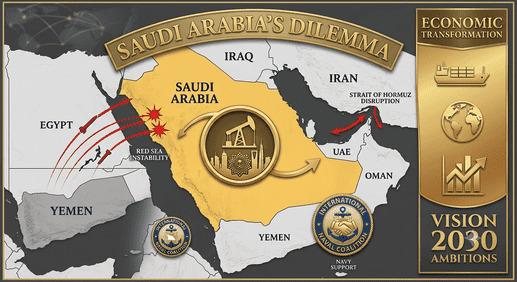
generated from AI
Saudi Arabia has spent years trying to keep itself away from the region’s wars and focus on economic transformation. But the widening conflict involving the United States, Iran and Iran-aligned armed groups is increasingly pulling the Kingdom into the centre of the crisis.
In recent days, Saudi Arabia has faced drone attacks on oil facilities from Iraqi territory, escalating threats from Yemen’s Iran-aligned Houthis against Saudi-linked shipping, and direct military action alongside the United States against Iran-backed armed groups in Iraq. Riyadh has also moved to strengthen international protection for shipping through the Red Sea.
The developments have changed Saudi Arabia’s position from that of a regional power seeking to avoid confrontation into one of the countries most directly exposed to the consequences of the expanding conflict.
A crisis spreading across Saudi Arabia’s borders
Saudi Arabia now faces pressure from several directions.
On July 27, the Saudi Defence Ministry said its air defences intercepted several drones launched from Iraqi territory that were attempting to target oil facilities in the Eastern Region and Riyadh. Saudi authorities attributed the launches to Iran-backed militias and said the Kingdom retained the right to respond.
Two days later, Reuters reported that US and Saudi forces struck sites belonging to Iran-backed groups in Iraq in retaliation for drone attacks directed at Saudi oil targets from Iraqi territory. The strikes marked a significant escalation because Saudi Arabia was no longer dealing only with attacks against its territory; it was participating directly in military action beyond its borders.
The development also exposed the growing difficulty for Riyadh of maintaining distance from the wider US-Iran confrontation.
The Red Sea is becoming a Saudi security concern
The second major pressure point is the Red Sea.
Yemen’s Houthi movement has declared a blockade against Saudi Arabia and has targeted Saudi-linked vessels and energy infrastructure. On July 28, the Houthis said they had fired ballistic missiles at a Saudi oil tanker in the Red Sea. Reuters reported that the group said the vessel had breached its newly declared blockade.
The Houthis also said on July 27 that they had targeted oil supply and transport facilities connecting Saudi Arabia’s eastern oil-producing region with Yanbu on the Red Sea. The claim was not independently confirmed by Saudi Aramco at the time.
For Saudi Arabia, the threat is strategically important because Yanbu has become more significant as an alternative export route while disruption continues around the Strait of Hormuz.
Reuters reported earlier in July that Saudi Arabia was considering expanding the capacity of its East-West oil pipeline to the Red Sea, allowing more crude to reach the western coast without passing through Hormuz.
That alternative route, however, also makes the Red Sea an increasingly important part of Saudi Arabia’s energy security.
Riyadh is building a wider maritime response
The threat to Red Sea shipping has pushed Saudi Arabia towards a broader international response.
On July 30, Riyadh unveiled plans for a multinational maritime defence coalition to protect international shipping and energy routes around the Red Sea, Bab el-Mandeb Strait and Gulf of Aden. The meeting behind the initiative brought representatives from 43 countries and the European Union together, while 14 countries formally supported the proposal.
The move came after Saudi Arabia had already sought international support for protecting Red Sea shipping from Houthi attacks. Reuters reported on July 29 that Riyadh was working to establish such a coalition as threats to Saudi-linked vessels increased.
The importance of the move extends beyond Saudi Arabia. Bab el-Mandeb is a major maritime chokepoint, and disruption there can affect trade, shipping costs, insurance and energy flows far beyond the Middle East.
Why Saudi oil is at the heart of the problem
Saudi Arabia’s role in the crisis cannot be separated from its position in the global energy system.
The Kingdom is one of the world’s most important oil producers, making any sustained threat to its production or export infrastructure a matter of international concern.
The Red Sea has become particularly important because Saudi Arabia has been using its western export infrastructure to reduce dependence on routes through the Strait of Hormuz. Reuters reported that the East-West pipeline, which connects the country’s eastern oil-producing region with Yanbu on the Red Sea, has become increasingly important since the disruption of shipping through Hormuz.
But the latest attacks show the vulnerability of that alternative.
On July 30, Reuters reported that two tankers carrying Saudi crude for India exited the Red Sea with their tracking transponders switched off, underscoring the security risks facing vessels using the route.
At the same time, Red Sea shipping has shown some signs of recovery. Reuters reported on July 31 that 29 commodity vessels transited the Bab el-Mandeb on Thursday, although traffic remained well below normal levels. The development suggests that the security situation is fluid rather than indicating a complete shutdown of the route.
Saudi Arabia’s difficult balancing act
The Kingdom now faces a strategic dilemma.
It has strong security ties with Washington and is increasingly taking military action against Iran-aligned groups. At the same time, Riyadh has a direct economic interest in preventing the conflict from expanding into a prolonged regional war.
Saudi Arabia’s economic transformation under Vision 2030 depends on investment, tourism, logistics and large infrastructure projects. Continued attacks on energy facilities, shipping routes or major population centres would threaten the stability that those ambitions require.
That helps explain why Riyadh has simultaneously strengthened its military response and sought greater international cooperation to secure maritime routes.
Why this matters beyond the Gulf
Saudi Arabia’s growing role means that the conflict is no longer confined to a single battlefield.
The confrontation now links the Gulf, Iraq, Yemen and the Red Sea. Attacks on Saudi oil facilities can trigger military operations in Iraq. Houthi attacks on Saudi-linked shipping can threaten Red Sea trade. Disruption in either the Red Sea or the Strait of Hormuz can affect global energy markets and international shipping.
The geography of Saudi Arabia makes the Kingdom a particularly important link between these fronts.
It borders Iraq to the north, Yemen to the south, the Red Sea to the west and the Gulf to the east. That location gives Riyadh major strategic importance�"but it also means that escalation elsewhere in the region can quickly become a Saudi security problem.
The question now facing Riyadh
Saudi Arabia is increasingly being drawn into the current phase of the regional confrontation, even as it seeks to protect its territory and avoid a wider war.
The creation of a proposed multinational maritime coalition and the Kingdom’s growing military coordination with the United States show that Riyadh is preparing for a tougher security environment.
At the same time, Saudi Arabia has strong reasons to favour stability. Its economic ambitions depend on secure trade routes, uninterrupted energy exports and an environment capable of attracting global investment.
The central question is therefore no longer whether Saudi Arabia is affected by the Middle East crisis. It clearly is.
The question is whether Riyadh can contain the threats emerging from Iraq, Yemen and the wider US-Iran confrontation without becoming one of the main battlefields of the region’s expanding war.
Loading...
Loading...
Also read






Editor : Iqbal Sobhan Chowdhury
Published by the Editor on behalf of the Observer Ltd. from Globe Printers, 24/A, New Eskaton Road, Ramna, Dhaka.
Editorial, News and Commercial Offices : Aziz Bhaban (2nd floor), 93, Motijheel C/A, Dhaka-1000.
Phone: PABX- 41053001-06; Advertisement: 41053012; 01793317829, 01550707291, E-mail: [email protected], [email protected] Online: email: [email protected] 41053014; 01550707297 Advertisement: 01550707296
Published by the Editor on behalf of the Observer Ltd. from Globe Printers, 24/A, New Eskaton Road, Ramna, Dhaka.
Editorial, News and Commercial Offices : Aziz Bhaban (2nd floor), 93, Motijheel C/A, Dhaka-1000.
Phone: PABX- 41053001-06; Advertisement: 41053012; 01793317829, 01550707291, E-mail: [email protected], [email protected] Online: email: [email protected] 41053014; 01550707297 Advertisement: 01550707296


