



| HEADLINE |

|

'The Fizz' hasn’t fizzled out, but the BCCI seems to have...



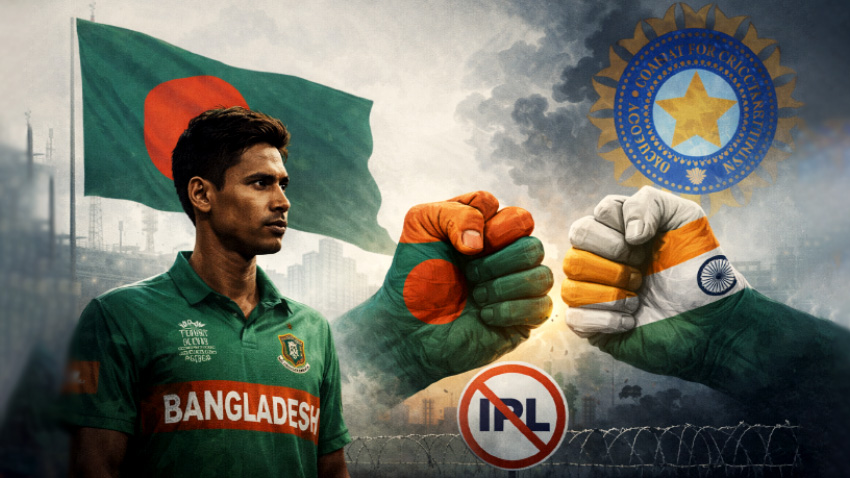
AI Generated
In an unprecedented escalation blurring the lines between sport and geopolitical tensions, Bangladesh and India are now facing a significant clash - triggered by a an avoidable squabble over the exclusion of Bangladeshi fast bowler Mustafizur Rahman from the Indian Premier League (IPL).
The Board of Control for Cricket in India (BCCI) reportedly instructed the Kolkata Knight Riders (KKR) to release Mustafizur from the IPL squad amid heightened domestic political pressure in India. The decision naturally ignites outrage in Bangladesh, since the pacer is a national figure as well as a source of immense pride. All live telecasts and promotions of the 2026 IPL have been indefinitely suspended in Bangladesh in protest against Mustafizur’s exclusion.
However, while the Bangladesh Government has logically and forcefully responded to the incident, we expect from our Indian counterpart not to politicize sporting decisions into political flashpoints. In addition, Bangladesh Cricket Board (BCB) has declared its team will not travel to India for the upcoming ICC Men’s T20 World Cup, and formally requested the International Cricket Council (ICC) to relocate its fixtures to Sri Lanka, citing security concerns.
The million dollars question, however, if the BCCI is actually so concerned about ensuring Fizz’s security, how will it ensure an entire team’s security during the upcoming T-20 World Cup?
As far as the broader context is concerned, the Mustafiz episode is less about one fast bowler, and more about his religion and national identity. If geopolitical tensions can quietly shape player participation in leagues that market themselves as global and merit oriented, then more Bangladeshi players will become vulnerable to political winds. BCCI will lose credibility as a neutral and accountable custodian of the sport. And this writer doesn’t want to see anymore Bangladeshi Cricketer to pay the unwelcoming price for mysterious and hidden political reasons which they are not responsible for.
Indian Cricket authorities must realise the fact - Cricket has long served as a rare neutral ground in South Asia — a space where rivalry is intense but rules are shared and where sanctity of the game ultimately prevails. Recent decisions surrounding the exclusion of Bangladeshi players from the IPL, suspension of IPL broadcasts in Bangladesh, and Dhaka’s reluctance to play World Cup matches in India is now manifestly undermining that valuable tradition, irrespective of all political and diplomatic rifts.
Cricket or whatever sports, when drawn into geopolitical disputes, ceases to be a unifying force and instead becomes collateral damage. Administrative decisions influenced by political pressure — whether actual or perceived — erode trust between sporting institutions and fuel public resentment on both sides. For millions of fans, players are ambassadors of skill and character, and not political proxy forces for diplomatic squabble or protests.
In fact - Cricket has often softened political edges, offering moments of shared joy even during difficult phases in bilateral relations. To weaponize the game now would be to reverse decades of quiet confidence-building achieved through soft power and people-to-people contact.
Practical and financial costs are even more - players are likely to lose professional opportunities, broadcasters and sponsors will suffer financially, and in the end it is the Cricket lovers who will be deprived of the sport at its best.
Most importantly, our younger generation will now absorb a disturbing message amid our tumultuous bi-lateral ties with India — a sporting talent can be overridden by poisonous communal politics, and also that sporting arenas have now turned into avenues for promoting populous political sentiments.
We have always believed that disagreements between states are inevitable. They must be addressed through diplomacy, dialogue, and institutional channels — not through selection tables, broadcast bans, or tournament boycotts. Cricket boards are meant to govern the game, not to mirror political anxieties.
If India and Bangladesh wish to preserve both their cricketing futures and their broader relationship, respecting the game is more important. The boundary between politics and sport may be thin, but it must be respected. Once crossed, it is difficult to redraw.
Cricket should remain what it has always promised to be – an enjoyable game built on the foundations of talent, skill and competition – not a game for displaying thinly veiled political protests or communal loathing.

The Board of Control for Cricket in India (BCCI) reportedly instructed the Kolkata Knight Riders (KKR) to release Mustafizur from the IPL squad amid heightened domestic political pressure in India. The decision naturally ignites outrage in Bangladesh, since the pacer is a national figure as well as a source of immense pride. All live telecasts and promotions of the 2026 IPL have been indefinitely suspended in Bangladesh in protest against Mustafizur’s exclusion.
However, while the Bangladesh Government has logically and forcefully responded to the incident, we expect from our Indian counterpart not to politicize sporting decisions into political flashpoints. In addition, Bangladesh Cricket Board (BCB) has declared its team will not travel to India for the upcoming ICC Men’s T20 World Cup, and formally requested the International Cricket Council (ICC) to relocate its fixtures to Sri Lanka, citing security concerns.
The million dollars question, however, if the BCCI is actually so concerned about ensuring Fizz’s security, how will it ensure an entire team’s security during the upcoming T-20 World Cup?
As far as the broader context is concerned, the Mustafiz episode is less about one fast bowler, and more about his religion and national identity. If geopolitical tensions can quietly shape player participation in leagues that market themselves as global and merit oriented, then more Bangladeshi players will become vulnerable to political winds. BCCI will lose credibility as a neutral and accountable custodian of the sport. And this writer doesn’t want to see anymore Bangladeshi Cricketer to pay the unwelcoming price for mysterious and hidden political reasons which they are not responsible for.
Indian Cricket authorities must realise the fact - Cricket has long served as a rare neutral ground in South Asia — a space where rivalry is intense but rules are shared and where sanctity of the game ultimately prevails. Recent decisions surrounding the exclusion of Bangladeshi players from the IPL, suspension of IPL broadcasts in Bangladesh, and Dhaka’s reluctance to play World Cup matches in India is now manifestly undermining that valuable tradition, irrespective of all political and diplomatic rifts.
Cricket or whatever sports, when drawn into geopolitical disputes, ceases to be a unifying force and instead becomes collateral damage. Administrative decisions influenced by political pressure — whether actual or perceived — erode trust between sporting institutions and fuel public resentment on both sides. For millions of fans, players are ambassadors of skill and character, and not political proxy forces for diplomatic squabble or protests.
In fact - Cricket has often softened political edges, offering moments of shared joy even during difficult phases in bilateral relations. To weaponize the game now would be to reverse decades of quiet confidence-building achieved through soft power and people-to-people contact.
Practical and financial costs are even more - players are likely to lose professional opportunities, broadcasters and sponsors will suffer financially, and in the end it is the Cricket lovers who will be deprived of the sport at its best.
Most importantly, our younger generation will now absorb a disturbing message amid our tumultuous bi-lateral ties with India — a sporting talent can be overridden by poisonous communal politics, and also that sporting arenas have now turned into avenues for promoting populous political sentiments.
We have always believed that disagreements between states are inevitable. They must be addressed through diplomacy, dialogue, and institutional channels — not through selection tables, broadcast bans, or tournament boycotts. Cricket boards are meant to govern the game, not to mirror political anxieties.
If India and Bangladesh wish to preserve both their cricketing futures and their broader relationship, respecting the game is more important. The boundary between politics and sport may be thin, but it must be respected. Once crossed, it is difficult to redraw.
Cricket should remain what it has always promised to be – an enjoyable game built on the foundations of talent, skill and competition – not a game for displaying thinly veiled political protests or communal loathing.
The writer is Editorial Chief, The Daily Observer

Loading...
Loading...
Also read



Editor : Iqbal Sobhan Chowdhury
Published by the Editor on behalf of the Observer Ltd. from Globe Printers, 24/A, New Eskaton Road, Ramna, Dhaka.
Editorial, News and Commercial Offices : Aziz Bhaban (2nd floor), 93, Motijheel C/A, Dhaka-1000.
Phone: PABX- 41053001-06; Advertisement: 41053012; 01793317829, 01550707291, E-mail: [email protected], [email protected] Online: email: [email protected] 41053014; 01550707297 Advertisement: 01550707296
Published by the Editor on behalf of the Observer Ltd. from Globe Printers, 24/A, New Eskaton Road, Ramna, Dhaka.
Editorial, News and Commercial Offices : Aziz Bhaban (2nd floor), 93, Motijheel C/A, Dhaka-1000.
Phone: PABX- 41053001-06; Advertisement: 41053012; 01793317829, 01550707291, E-mail: [email protected], [email protected] Online: email: [email protected] 41053014; 01550707297 Advertisement: 01550707296


