



| HEADLINE |

|
Organic watermelon farming boosts yield, rural economy in Bhola's Charfesson
Published : Friday, 17 April, 2026 at 5:53 PM
Upazila Representative


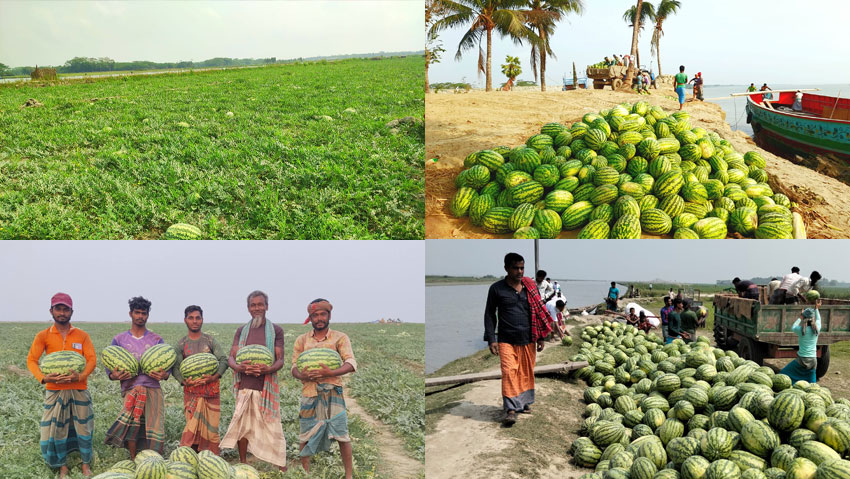
Farmers in Charfesson upazila in Bhola district are seeing higher yields and lower costs by shifting to organic methods in watermelon cultivation, bringing new momentum to the local rural economy.
Farmers have moved away from chemical dependence, adopting organic fertilizers and bio-pesticides. This transition has resulted in improved yields, reduced production costs and renewed optimism.
Ismail Majhi, a farmer from Charfesson upazila, said he benefited significantly this year after following agricultural officers’ advice to use organic inputs.
Cultivating watermelon on two and a half acres of land, he earned around Tk200,000 in profit after covering all expenses, including land leasing costs.
Harvesting begins early in the morning, with teams of workers gathering in the fields. Some sort the fruits while others load them onto trucks.
At nearby river ghats, large cargo vessels and launches transport the produce to major markets including Barishal, Dhaka and Chattogram. Wholesalers from big cities are now coming directly to the fields, turning farms into active trading hubs.
This seasonal activity has energized village life. Day laborers find steady work, women participate in sorting and transportation and even teenagers earn income through small tasks. Temporary roadside stalls have sprung up, and local markets are bustling, accelerating the rural economy.
According to Charfesson upazila agriculture office, watermelon has been cultivated on 12,875 hectares of land this year, featuring varieties such as Glory, Hybrid, Dragon, Thai Super, Cycling, Bengal King, Grade One, Big Family and Ananda. Organic fertilizers and bio-pesticides were used on around 40 acres under a project by Department of Agricultural Extension’s tissue culture laboratory and horticulture center development initiative.
Last year, many farmers suffered losses due to excessive use of chemical pesticides, which led to lower yields, higher costs and increased pest problems.
Learning from that experience, farmers adopted organic methods this season following guidance from agricultural officials, resulting in better outcomes.
Farmer Azizur Rahman said perceptions have changed: earlier, more chemicals were seen as the key to higher yield, but now farmers understand that proper methods with lower costs can bring better profits.
Another farmer, Shakil Farazi, cultivated watermelons organically on three acres for the first time and achieved higher yields than others.
He noted that training from the agriculture department helped farmers learn about proper planting times, balanced fertilization, and pest management. Demonstration plots also allowed farmers to learn through observation.
Upazila Agriculture Officer Md. Nazmul Huda said many farmers are shifting from rice cultivation to watermelon farming due to consistent success. Compared to last year, cultivation has expanded significantly.
He added that organic farming under the tissue culture project produces watermelons weighing three to five kilograms, which are popular among consumers for their quality and appearance, ensuring better market prices.
Project Director Talha Zubair Masrur said modern, technology-based watermelon farming has led to a bumper harvest this season. Farmers were trained in best practices, including the use of balanced fertilizers, proper cultivation techniques and timely planting of suitable varieties.
Agricultural economist Dr. Jahangir Alam emphasized that combining organic methods, modern technology, and proper training can transform coastal agriculture.
However, he stressed the need to ensure easy access to organic inputs, regular farmer training and improvements in market and transport systems to sustain this progress and guarantee fair prices.
SF/SH
Farmers have moved away from chemical dependence, adopting organic fertilizers and bio-pesticides. This transition has resulted in improved yields, reduced production costs and renewed optimism.
Ismail Majhi, a farmer from Charfesson upazila, said he benefited significantly this year after following agricultural officers’ advice to use organic inputs.
Cultivating watermelon on two and a half acres of land, he earned around Tk200,000 in profit after covering all expenses, including land leasing costs.
Harvesting begins early in the morning, with teams of workers gathering in the fields. Some sort the fruits while others load them onto trucks.
At nearby river ghats, large cargo vessels and launches transport the produce to major markets including Barishal, Dhaka and Chattogram. Wholesalers from big cities are now coming directly to the fields, turning farms into active trading hubs.
This seasonal activity has energized village life. Day laborers find steady work, women participate in sorting and transportation and even teenagers earn income through small tasks. Temporary roadside stalls have sprung up, and local markets are bustling, accelerating the rural economy.
According to Charfesson upazila agriculture office, watermelon has been cultivated on 12,875 hectares of land this year, featuring varieties such as Glory, Hybrid, Dragon, Thai Super, Cycling, Bengal King, Grade One, Big Family and Ananda. Organic fertilizers and bio-pesticides were used on around 40 acres under a project by Department of Agricultural Extension’s tissue culture laboratory and horticulture center development initiative.
Last year, many farmers suffered losses due to excessive use of chemical pesticides, which led to lower yields, higher costs and increased pest problems.
Learning from that experience, farmers adopted organic methods this season following guidance from agricultural officials, resulting in better outcomes.
Farmer Azizur Rahman said perceptions have changed: earlier, more chemicals were seen as the key to higher yield, but now farmers understand that proper methods with lower costs can bring better profits.
Another farmer, Shakil Farazi, cultivated watermelons organically on three acres for the first time and achieved higher yields than others.
He noted that training from the agriculture department helped farmers learn about proper planting times, balanced fertilization, and pest management. Demonstration plots also allowed farmers to learn through observation.
Upazila Agriculture Officer Md. Nazmul Huda said many farmers are shifting from rice cultivation to watermelon farming due to consistent success. Compared to last year, cultivation has expanded significantly.
He added that organic farming under the tissue culture project produces watermelons weighing three to five kilograms, which are popular among consumers for their quality and appearance, ensuring better market prices.
Project Director Talha Zubair Masrur said modern, technology-based watermelon farming has led to a bumper harvest this season. Farmers were trained in best practices, including the use of balanced fertilizers, proper cultivation techniques and timely planting of suitable varieties.
Agricultural economist Dr. Jahangir Alam emphasized that combining organic methods, modern technology, and proper training can transform coastal agriculture.
However, he stressed the need to ensure easy access to organic inputs, regular farmer training and improvements in market and transport systems to sustain this progress and guarantee fair prices.
SF/SH
Loading...
Loading...
Also read








Editor : Iqbal Sobhan Chowdhury
Published by the Editor on behalf of the Observer Ltd. from Globe Printers, 24/A, New Eskaton Road, Ramna, Dhaka.
Editorial, News and Commercial Offices : Aziz Bhaban (2nd floor), 93, Motijheel C/A, Dhaka-1000.
Phone: PABX- 41053001-06; Advertisement: 41053012; 01793317829, 01550707291, E-mail: [email protected], [email protected] Online: email: [email protected] 41053014; 01550707297 Advertisement: 01550707296
Published by the Editor on behalf of the Observer Ltd. from Globe Printers, 24/A, New Eskaton Road, Ramna, Dhaka.
Editorial, News and Commercial Offices : Aziz Bhaban (2nd floor), 93, Motijheel C/A, Dhaka-1000.
Phone: PABX- 41053001-06; Advertisement: 41053012; 01793317829, 01550707291, E-mail: [email protected], [email protected] Online: email: [email protected] 41053014; 01550707297 Advertisement: 01550707296


