



| HEADLINE |

|

Trading sweat for survival in Charfesson's biweekly labor market
Published : Friday, 1 May, 2026 at 10:50 PM
Shipu Farazi


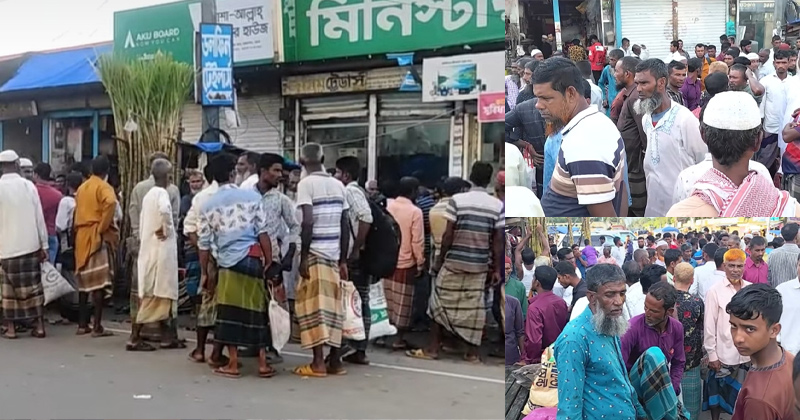
In the coastal upazila of Charfesson, a unique market convenes every Saturday and Tuesday. But instead of fresh produce or consumer goods, the commodity traded here is bone-breaking human labor. Hundreds of marginalized workers from remote islands gather twice a week to sell their physical strength to local employers in a desperate bid for survival.
Armed with spades, baskets, masonry tools, and sickles, laborers from isolated areas like Dhalchar, Kukri-Mukri, and Nazrul Nagar flock to a designated street near a local primary school.
Operating from mid-afternoon until evening, the gathering is locally known as the migrant workers market. Through intense bargaining, laborers are hired for earthmoving, harvesting, masonry, or domestic chores. Daily wages range from 800 to 1,000 taka, which typically includes three meals and snacks, though some secure monthly contracts.
For many of these laborers, the market is their only defense against extreme poverty and climate-induced displacement. Hayat Ali, a sexagenarian from the isolated East Dhalchar island, has lost his home and farmland to river erosion at least ten times. With fishing as the only alternative in his village, he travels to the market to earn a modest monthly income through grueling manual labor.
Similarly, Khayer Munshi, an elderly former religious teacher with failing eyesight, takes on heavy earthmoving jobs to afford his sick wife's medical bills and his children's education.
Abdullah, a young man who dropped out of school to support his family after his father's death, frequents the market for daily masonry gigs.
Abul Hossain, a labor group leader from Majher Char, noted that the absolute lack of employment opportunities on newly formed river shoals forces men to travel to the mainland for work.
The setup provides local residents and businessmen with a steady supply of affordable manpower. Monowar Hossain, a local teacher, visited the market to hire three workers for digging an underground water tank.
Meanwhile, businessman Jamal Uddin Mia hired a team of eight men to raise the embankments of his pond ahead of the monsoon season. While most workers find employment by the end of the day, a few inevitably return home empty-handed.
Reflecting on the laborers' plight, Charfesson Upazila Nirbahi Officer (UNO) Rumana Afroz noted that discussions on fair wages and working hours usually surface only around May Day, with little real-world implementation.
She remarked that the sweat of these laborers never truly dries, as it is constantly mingled with the tears of their daily hardships, urging a genuine societal shift toward fair labor rights and exploitation-free employment.

Loading...
Loading...
Also read







Editor : Iqbal Sobhan Chowdhury
Published by the Editor on behalf of the Observer Ltd. from Globe Printers, 24/A, New Eskaton Road, Ramna, Dhaka.
Editorial, News and Commercial Offices : Aziz Bhaban (2nd floor), 93, Motijheel C/A, Dhaka-1000.
Phone: PABX- 41053001-06; Advertisement: 41053012; 01793317829, 01550707291, E-mail: [email protected], [email protected] Online: email: [email protected] 41053014; 01550707297 Advertisement: 01550707296
Published by the Editor on behalf of the Observer Ltd. from Globe Printers, 24/A, New Eskaton Road, Ramna, Dhaka.
Editorial, News and Commercial Offices : Aziz Bhaban (2nd floor), 93, Motijheel C/A, Dhaka-1000.
Phone: PABX- 41053001-06; Advertisement: 41053012; 01793317829, 01550707291, E-mail: [email protected], [email protected] Online: email: [email protected] 41053014; 01550707297 Advertisement: 01550707296


