



| HEADLINE |

|
Dhaka air quality ranks 4th most polluted globally
Published : Wednesday, 6 May, 2026 at 10:39 AM
Observer Online Report


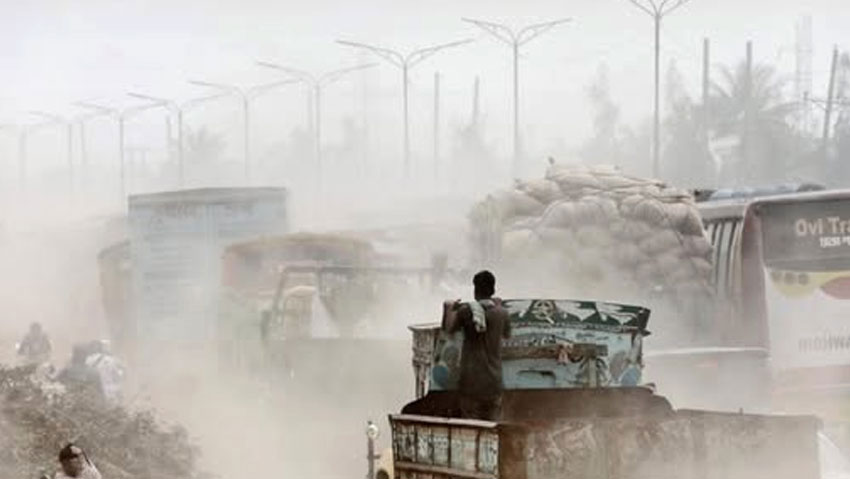
Air quality in Dhaka was recorded as “unhealthy for sensitive groups” on Wednesday morning, as the city ranked fourth among the world’s most polluted, with an Air Quality Index (AQI) score of 148 at 08:52 AM.
According to AQI standards, this level poses increased health risks for vulnerable groups, including children, the elderly, pregnant individuals and people with heart or lung conditions.
At the top of the pollution ranking were Lahore, Delhi, and Karachi, with AQI scores of 193, 159, and 154 respectively.
The AQI scale categorizes readings between 101 and 150 as “unhealthy for sensitive groups,” 151 to 200 as “unhealthy,” 201 to 300 as “very unhealthy,” and anything above 301 as “hazardous,” indicating severe health risks.
The AQI is a daily indicator that measures how clean or polluted the air is and outlines possible health effects. In Bangladesh, the index is calculated based on five key pollutants: particulate matter (PM10 and PM2.5), nitrogen dioxide, carbon monoxide, sulfur dioxide and ozone.
The capital has long struggled with air pollution, with conditions typically worsening during winter months and improving during the monsoon season.
According to World Health Organization, air pollution is responsible for an estimated seven million deaths worldwide each year, largely due to stroke, heart disease, chronic respiratory illnesses, lung cancer and acute respiratory infections.
SH
Loading...
Loading...
Also read








Editor : Iqbal Sobhan Chowdhury
Published by the Editor on behalf of the Observer Ltd. from Globe Printers, 24/A, New Eskaton Road, Ramna, Dhaka.
Editorial, News and Commercial Offices : Aziz Bhaban (2nd floor), 93, Motijheel C/A, Dhaka-1000.
Phone: PABX- 41053001-06; Advertisement: 41053012; 01793317829, 01550707291, E-mail: [email protected], [email protected] Online: email: [email protected] 41053014; 01550707297 Advertisement: 01550707296
Published by the Editor on behalf of the Observer Ltd. from Globe Printers, 24/A, New Eskaton Road, Ramna, Dhaka.
Editorial, News and Commercial Offices : Aziz Bhaban (2nd floor), 93, Motijheel C/A, Dhaka-1000.
Phone: PABX- 41053001-06; Advertisement: 41053012; 01793317829, 01550707291, E-mail: [email protected], [email protected] Online: email: [email protected] 41053014; 01550707297 Advertisement: 01550707296


