



| HEADLINE |

|

Cow farmers in Meherpur spend busy time ahead of Eid-ul-Azha
Published : Tuesday, 12 May, 2026 at 12:00 AM
M R Alam


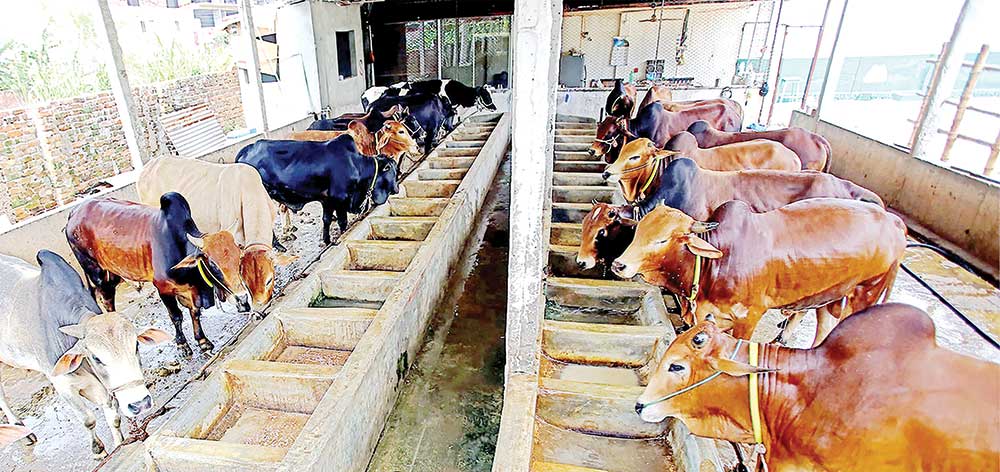 MEHERPUR, May 11: Cow farmers in Meherpur are spending a busy time fattening their cattle ahead of Eid-ul-Azha. They are taking care of the cows from morning until late at night.
 As fattening cows artificially is quite risky, they are using completely natural food. However, farmers are worried about the fear of Indian cows being imported. Meanwhile, animal experts advise buyers to test animals before purchasing and sacrificing them.
According to the Meherpur District Livestock Department, one lakh 72 thousand cows, buffaloes, goats and sheep have been kept ready in 26 thousand 775 commercial and family farms in the district ahead of Eid-ul-Azha. The district needs 90 thousand animals for sacrifice.
Farmers hope to get the desired price during the sacrifice, as the price of cattle has been high throughout the year. The cost of each cow is Tk 50 to 70 thousand, but farmers are expecting Tk 80 thousand to one lakh Taka per cow.
These farmers have fattened their cows by feeding them paddy straw, raw grass, oilcake, wheat bran, gram, rice, and rice husks. They have demanded that genuine farmers be kept under control so that they are not harmed by unscrupulous farmers, and that such unscrupulous farmers be identified. The farmers also demand that Indian cows should not be imported, either legally or illegally, ahead of Eid-ul-Adha. Otherwise, farmers will not get the desired price, which will discourage affected farmers and livestock keepers from animal husbandry.
Haji Abu Naeem, owner of Baliaghat Ma Agro Farm in Gangni, said that 60 cows are being fattened on his farm. Among them, 40 are Haryan and 20 are Nepalese cows. He is feeding them completely indigenous fodder, so the cost is low. In other years, many farmers used hormonal drugs to fatten cows, as a result of which several cows died. Sometimes it was found that owners or traders were forced to bring cows back from the markets because they could not sell them. For this reason, cows are now being nurtured using indigenous technology. He is optimistic that if animals are not imported from India, he will get the desired price.
Inamul Haque, a cow farmer from Malsadah Village in Gangni, said that he has 18 Nepalese and 12 Haryan breed cows on his farm. There is a risk in fattening cows using harmful injections and tablets, and many times the cows die. As a result, cows are being fattened using indigenous methods without taking any risks. However, they are worried about the propaganda among urban people that steroids and hormones are being used to fatten cows.
Kalu from Sahrabaria Village of Gangni Upazila is fattening cows as a family farm. He is nurturing 5 Haryan breed cows at home. He will take the cows to Dhaka markets this time too. He said that the cost of nurturing cows, including fodder and medicine, increases every year, but the price of cows has not increased in comparison. Traders are coming to his house but are offering a much lower price. The price the traders are telling him does not cover even half of the nurturing cost. Despite that, he is still hoping for profit. However, he also advises against importing animals from neighbouring India.
Kunjanagar cattle trader Shafiuddin said that he took 210 cows to Dhaka last year. This time, he will take at least 300 cows to Dhaka markets. He has already started visiting villages to select cattle. All the farmers and families are nurturing animals naturally with local fodder. As a result, there is no risk to farmers and traders this time. The District Livestock Officer (DLO) Dr. Tofazzel Hossain said that all measures have been taken to ensure that Indian cows do not come across the border at any time ahead of Eid.
Loading...
Loading...
Also read



Editor : Iqbal Sobhan Chowdhury
Published by the Editor on behalf of the Observer Ltd. from Globe Printers, 24/A, New Eskaton Road, Ramna, Dhaka.
Editorial, News and Commercial Offices : Aziz Bhaban (2nd floor), 93, Motijheel C/A, Dhaka-1000.
Phone: PABX- 41053001-06; Advertisement: 41053012; 01793317829, 01550707291, E-mail: [email protected], [email protected] Online: email: [email protected] 41053014; 01550707297 Advertisement: 01550707296
Published by the Editor on behalf of the Observer Ltd. from Globe Printers, 24/A, New Eskaton Road, Ramna, Dhaka.
Editorial, News and Commercial Offices : Aziz Bhaban (2nd floor), 93, Motijheel C/A, Dhaka-1000.
Phone: PABX- 41053001-06; Advertisement: 41053012; 01793317829, 01550707291, E-mail: [email protected], [email protected] Online: email: [email protected] 41053014; 01550707297 Advertisement: 01550707296


