



| HEADLINE |

|

20 thousand people trained in leather preservation ahead of Eid: Minister
Published : Monday, 25 May, 2026 at 6:37 PM
Observer Online Report


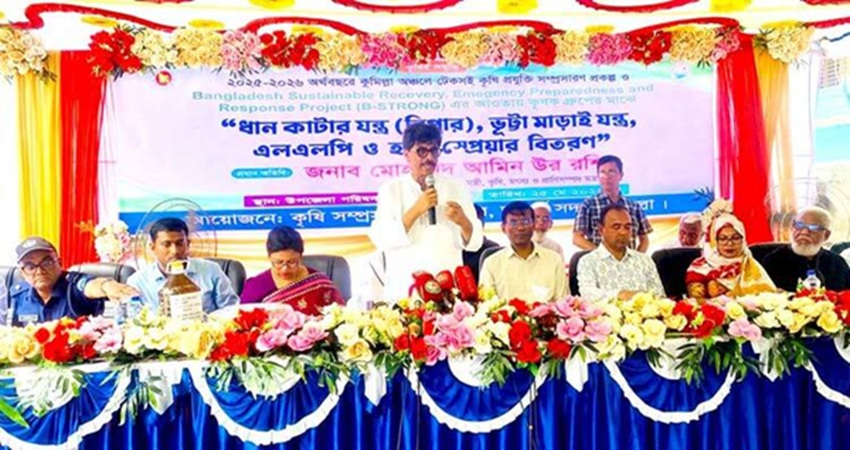
Food, Agriculture, Fisheries and Livestock Minister Mohammad Amin Ur Rashid has said that around 20,000 to 22,000 people have been trained in leather preservation to improve the quality of sacrificial animal hides during Eid-ul-Adha.
He made the remarks on Monday after a farm machinery distribution programme organised by the Department of Agricultural Extension at Adarsha Sadar upazila parishad premises in Cumilla.
The minister said around 60 to 70 per cent of raw hides collected during Eid-ul-Adha in the country are usually graded as B-category due to damage caused during skinning.
“In many cases, the quality of hides deteriorates because of carelessness while removing the skin from the animal body. Although there is uncertainty over how much leather can be preserved properly this year, the situation will improve next year,” he said.
He added that rawhide is a highly sensitive product and can quickly deteriorate if salt is not applied in proper quantity and on time.
“If this management system can be improved, tannery owners will also buy hides at higher prices,” the minister added.
Highlighting the importance of agriculture, Amin Ur Rashid said nearly 75 per cent of the country’s people are directly or indirectly connected with the sector and improvement in agriculture would strengthen the overall economic condition of the people.
He also said the government has taken various plans centring Eid-ul-Adha this year.
Referring to the condition of farmers in the past, the minister said many farmers had suffered different forms of exploitation, including cases where loans were taken in farmers’ names by others.
“The current government is working to bring farmers out of such situations,” he added.
Among others, Adarsha Sadar Upazila Nirbahi Officer (UNO) Fatema Tuz Zahra, Upazila Agriculture Officer Md Nizam Uddin, Touhidul Anwar and local community leaders were present at the programme.
During the event, mango saplings of a popular Thai banana variety, paddy harvesting machines, corn threshers, LLPs and hand sprayers were distributed among farmers.
Loading...
Loading...
Also read



Editor : Iqbal Sobhan Chowdhury
Published by the Editor on behalf of the Observer Ltd. from Globe Printers, 24/A, New Eskaton Road, Ramna, Dhaka.
Editorial, News and Commercial Offices : Aziz Bhaban (2nd floor), 93, Motijheel C/A, Dhaka-1000.
Phone: PABX- 41053001-06; Advertisement: 41053012; 01793317829, 01550707291, E-mail: [email protected], [email protected] Online: email: [email protected] 41053014; 01550707297 Advertisement: 01550707296
Published by the Editor on behalf of the Observer Ltd. from Globe Printers, 24/A, New Eskaton Road, Ramna, Dhaka.
Editorial, News and Commercial Offices : Aziz Bhaban (2nd floor), 93, Motijheel C/A, Dhaka-1000.
Phone: PABX- 41053001-06; Advertisement: 41053012; 01793317829, 01550707291, E-mail: [email protected], [email protected] Online: email: [email protected] 41053014; 01550707297 Advertisement: 01550707296


