



| HEADLINE |

|

World Cup excitement can inspire a new generation of young soccer fans


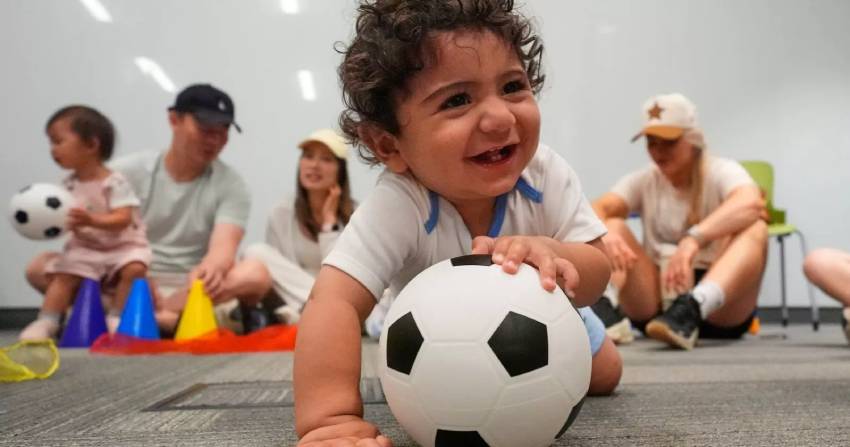
Ten-month-old Zain Fawaz plays with a soccer ball at a program introducing toddlers to the sport ahead of the World Cup soccer tournament Thursday, June 4, 2026, in Lenexa, Kan. (AP Photo)
The excitement surrounding the FIFA World Cup could help attract more young children to soccer in the United States, with experts saying the tournament may inspire a new generation of players and lifelong fans.
At a World Cup-themed event for toddlers at a library in suburban Kansas City, 17-month-old Jude Cornell eagerly chased soccer balls and played with training equipment while his mother, Kyra Cornell, joked that she was already imagining his future in the sport.
The event took place about 20 miles (32 kilometers) from one of the stadiums hosting World Cup matches, reflecting the growing enthusiasm for soccer across the country.
Soccer is already one of the most popular youth sports in the United States. According to the Aspen Institute, 7.5% of children aged 6 to 12 played organized soccer in 2024. While that is slightly lower than a decade ago, only baseball and basketball attracted more young participants.
Experts say youth participation has long helped turn players into devoted fans.
Eighteen-year-old Haley Garbowski, who recently won a state high school championship in Missouri, is one example. A regular attendee at professional women’s soccer matches, she now helps coach younger children at a summer sports camp and plans to study business and sports marketing at San Diego State University.
Her experience also reflects how soccer fandom often grows within families. While her grandparents never followed the sport, her mother gradually became a fan after watching her daughter play.
Michael Lewis, a sports marketing professor at Emory University, said soccer’s popularity has been growing steadily across generations.
“Soccer is a generational story that’s building generation after generation, but it takes a long, long time,” he said.
Although soccer still trails baseball, basketball and American football in overall popularity, researchers see increasing interest among younger Americans, particularly Millennials and Generation Z.
The sport’s growth in the United States began accelerating in the 1970s, when international stars such as Pelé played in the now-defunct North American Soccer League. Interest continued to rise after the United States hosted the FIFA World Cup in 1994 and launched Major League Soccer (MLS) two years later.
Today’s youth soccer system is also much stronger than in previous decades, with competitive academies, travel teams and MLS development programs helping produce better players.
Experts say the success of women’s soccer has also played a major role in expanding the sport. More girls are joining youth leagues, helping keep participation high while creating a larger fan base.
Nicholas Watanabe, a professor at the University of South Carolina, said the long-term success of women’s soccer has benefited the men’s game as well.
In Kansas City, the professional women’s team, the Kansas City Current, has become another sign of the sport’s growth. The club plays in the first stadium built specifically for a women’s professional soccer team and has been involved in local World Cup community events.
Despite the progress, analysts say soccer still faces challenges in competing with America’s most popular sports. Many of the world’s best players compete in Europe, and many American fans follow European clubs instead of MLS teams.
Still, experts believe the sport is in its strongest position yet in the United States.
Darin White, executive director of the Center for Sports Analytics at Samford University, said he is more optimistic than ever about soccer’s future in the country, pointing to its growing popularity among younger fans and increasing interest from marketers.
Back at the Kansas library, toddlers continued kicking soccer balls around while one child proudly repeated the name “Messi,” referring to Argentine star Lionel Messi, reports UNB.
As for Jude Cornell, his mother said she hopes to enroll him in a local soccer program once he is old enough.
“You don’t know,” she said with a smile. “Maybe next spring or summer we start trying.”









Published by the Editor on behalf of the Observer Ltd. from Globe Printers, 24/A, New Eskaton Road, Ramna, Dhaka.
Editorial, News and Commercial Offices : Aziz Bhaban (2nd floor), 93, Motijheel C/A, Dhaka-1000.
Phone: PABX- 41053001-06; Advertisement: 41053012; 01793317829, 01550707291, E-mail: [email protected], [email protected] Online: email: [email protected] 41053014; 01550707297 Advertisement: 01550707296


