



| HEADLINE |

|
Watermelon: The story behind holy land's national emblem
Published : Monday, 3 August, 2026 at 7:40 PM
Special Correspondent


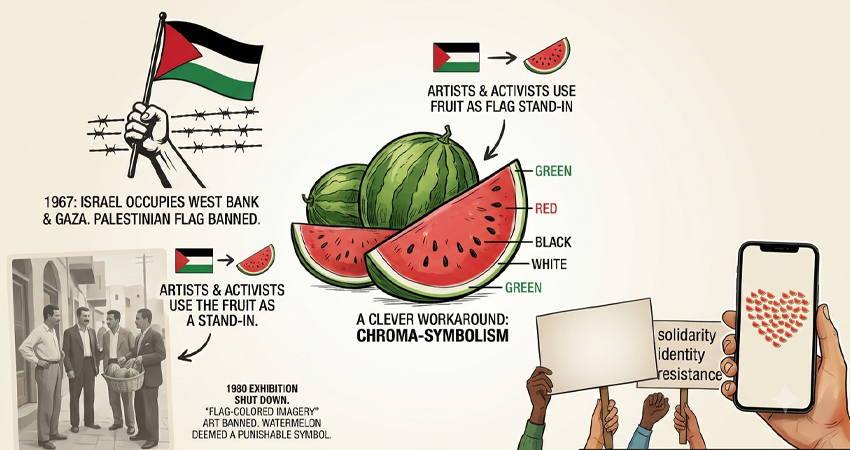
AI image
August 3 marks National Watermelon Day around the world. The fruit is sweet, refreshing, and packed with nutrients - but few know that this humble fruit carries a decades-long connection to Palestinian resistance and solidarity. Here's a brief look at how it happened.
1967. Israel occupies the West Bank and Gaza after the Six-Day War. Following the occupation, authorities prohibited the public display of the Palestinian flag. The flag - comprising red, white, black, and green - was identified as a political symbol and banned in these areas.
Unable to hoist their flag in public, residents of the region found a clever workaround - the watermelon. The connection is chiefly chromatic.
A sliced watermelon shows the exact same colors as the Palestinian flag - red flesh, white rind, black seeds, and green skin. Palestinian artists and activists began using the fruit as a stand-in for the flag, expressing resistance and solidarity without technically breaking the law.
The first officially documented instance of this connection dates to a 1980 exhibition, when Israeli authorities shut down a show by Palestinian artists. The reason - the art was made up of flag-colored imagery.
Occupying officials reportedly went as far as deeming a watermelon slice a punishable political symbol - restrictions that only cemented the fruit's association with Palestinian identity more firmly.
The ban on displaying the flag was formally lifted with the 1993 Oslo Accords. But by then, the watermelon had already taken root as an enduring emblem of Palestinian identity - one that would resurface decades later.
The symbol saw a major revival in the digital age, particularly during the 2021 Gaza conflict and again after October 2023. As social media platforms flagged or restricted explicitly political content, users - including artists, celebrities, and everyday people - turned to watermelon imagery and emojis as a way to express solidarity while avoiding content moderation.
Today, the watermelon appears in murals, protest signs, clothing, and digital art - a widely recognized, unofficial emblem of Palestinian identity and resistance, born from a ban but grown into something far more lasting.
-SA
Loading...
Loading...
Also read





Editor : Iqbal Sobhan Chowdhury
Published by the Editor on behalf of the Observer Ltd. from Globe Printers, 24/A, New Eskaton Road, Ramna, Dhaka.
Editorial, News and Commercial Offices : Aziz Bhaban (2nd floor), 93, Motijheel C/A, Dhaka-1000.
Phone: PABX- 41053001-06; Advertisement: 41053012; 01793317829, 01550707291, E-mail: [email protected], [email protected] Online: email: [email protected] 41053014; 01550707297 Advertisement: 01550707296
Published by the Editor on behalf of the Observer Ltd. from Globe Printers, 24/A, New Eskaton Road, Ramna, Dhaka.
Editorial, News and Commercial Offices : Aziz Bhaban (2nd floor), 93, Motijheel C/A, Dhaka-1000.
Phone: PABX- 41053001-06; Advertisement: 41053012; 01793317829, 01550707291, E-mail: [email protected], [email protected] Online: email: [email protected] 41053014; 01550707297 Advertisement: 01550707296


