



| HEADLINE |

|
Snail harvesting threatens aquatic biodiversity in Gopalganj wetland
Published : Friday, 14 August, 2026 at 12:00 AM
Our Correspondent


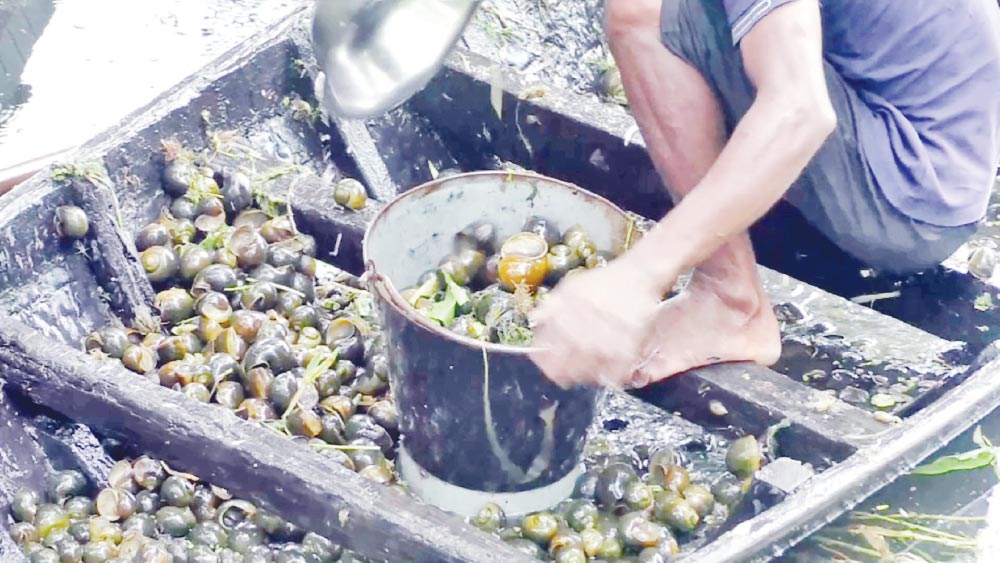 GOPALGANJ, Aug 13: Once abundant in the wetlands of Gopalganj, snails are becoming increasingly scarce as large quantities are being harvested from beels and canals every day, raising concerns over the impact on aquatic biodiversity.
Local residents said around 500 sacks of snails are bought and sold daily at different collection points across the district.
The snails are collected from several wetlands, including Satpar, Singa, Baraitala, Mathbari, Rahuthar, Barampalta, Pathargram, Barakhola and Chandar Beel, before being taken to local trading centres.
A recent visit found men and women of different ages wading into the wetlands to collect snails. Some used baskets while others carried sacks, gathering the snails from the water before taking them to designated collection points.
According to locals, thousands of people depend on snail collection and sales for their livelihoods, particularly during periods when there is little other work available in the wetland areas.
Local collectors usually gather the snails using small boats. Middlemen then buy the snails in bulk and sell them to shrimp farms, where they are reportedly used as feed.
While snail collection provides an income for many poor families, residents fear that excessive harvesting could disrupt the ecological balance of the wetlands.
Gopalganj District Fisheries Officer Md Kamrul Islam said they would hold meetings with snail collectors and traders and request them to refrain from the practice.
“We will also advise them to look for alternative sources of employment during this period,” he said.
Dr Md Rasheduzzaman, Assistant Professor and Chairman of the Department of Environmental Science at Gopalganj Science and Technology University, said every species plays a role in maintaining the biodiversity of an aquatic ecosystem.
“Excessive snail harvesting can affect the food chain in aquatic ecosystems. So, there should be a system to regulate snail collection,” he said.
Experts and local residents called for regular monitoring and awareness campaigns by the authorities to prevent excessive harvesting.
They also urged local representatives, the fisheries department and relevant environmental agencies to work together to protect biodiversity in the wetlands.
Loading...
Loading...
Also read



Editor : Iqbal Sobhan Chowdhury
Published by the Editor on behalf of the Observer Ltd. from Globe Printers, 24/A, New Eskaton Road, Ramna, Dhaka.
Editorial, News and Commercial Offices : Aziz Bhaban (2nd floor), 93, Motijheel C/A, Dhaka-1000.
Phone: PABX- 41053001-06; Advertisement: 41053012; 01793317829, 01550707291, E-mail: [email protected], [email protected] Online: email: [email protected] 41053014; 01550707297 Advertisement: 01550707296
Published by the Editor on behalf of the Observer Ltd. from Globe Printers, 24/A, New Eskaton Road, Ramna, Dhaka.
Editorial, News and Commercial Offices : Aziz Bhaban (2nd floor), 93, Motijheel C/A, Dhaka-1000.
Phone: PABX- 41053001-06; Advertisement: 41053012; 01793317829, 01550707291, E-mail: [email protected], [email protected] Online: email: [email protected] 41053014; 01550707297 Advertisement: 01550707296


