



| HEADLINE |

|

Workers, recruiters welcome reopening of Malaysia labour market
Published : Sunday, 23 August, 2026 at 9:39 PM
Special Correspondent


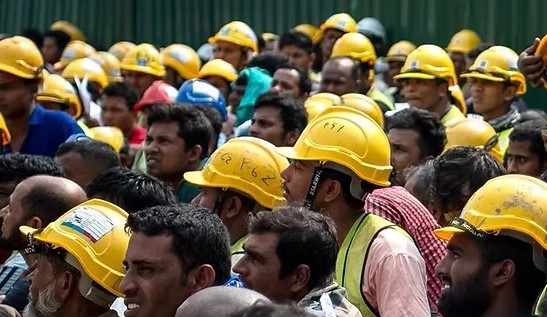
Collected Photo
Amid criticism for reopening the Malaysian labour market with only 25 international recruiting agencies, intending migrant workers and some recruiting businesses have welcomed the reopening of the labour market after more than two years, expressing gratitude to Prime Minister Tarique Rahman, Expatriates’ Welfare and Overseas Employment Minister Ariful Haque Choudhury and others involved in the process.
They said the reopening is expected to create new opportunities for Bangladeshi workers, boost remittance inflows and allow a wider range of licensed recruiting agencies to participate in the recruitment process.
According to sources, Malaysia has introduced changes to the recruitment mechanism. Employers and companies holding recruitment approvals will be able to choose from 25 agencies listed by Malaysia’s Foreign Workers Centralized Management System (FWCMS). Recruiting agencies will reportedly be able to send workers by paying a fee of Tk6,000 to the selected 25 agencies for processing while 312 government-approved Bangladeshi agencies are expected to receive opportunities to conduct business under the new arrangement.
Efforts are also underway to bring other licensed agencies under the system. Agencies may be able to process BMET clearance for jobs secured under their own licences, subject to approval through one of the 25 designated agencies, potentially simplifying the migration process and broadening business participation, according to relevant sources.
A section of Bangladeshi recruiting agencies, however, have been protesting the Malaysian decision to reopen the market with only 25 agencies claiming it as a new syndicating step.
Malaysia, one of Bangladesh’s largest overseas employment destinations after Saudi Arabia, recruited around 480,000 Bangladeshi workers between 2022 and May 31, 2024. The Malaysian labour market was closed to Bangladesh and several other source countries on May 31, 2024, with the entry of new foreign workers halted from June 1.
On Friday last, FWCMS published a list of 25 Bangladeshi recruiting agencies, reviving hopes among aspiring migrant workers. However, the Malaysian government has yet to formally announce when recruitment will begin and the exact procedures for bringing in workers.
Manpower businessman Nazim Uddin of Dhaka’s Nayapaltan said Malaysia remained an attractive destination because it recruited both skilled and unskilled workers and offered comparatively favourable wages and working conditions.
“Malaysia has a minimum wage of 1,700 ringgit (MR) along with overtime opportunities. Its religious and cultural environment is also familiar to Bangladeshi workers,” he said, adding that the reopening could enable workers to secure safer employment at lower migration costs.
Businessman Shafi Uddin of Kakrail said the reopening came at an important time, as overseas employment opportunities in parts of the Middle East had declined following regional instability.
He alleged that whenever efforts were made to reopen the Malaysian market, certain groups attempted to create obstacles through protests, statements and what he described as misleading information. He called for action against those involved in illegal migration.
Prospective migrants also expressed relief. Mahiyuddin Rinku of Chatkhil in Noakhali, whose relative has been working in Malaysia since 2024, said he had been waiting for the calling visa to reopen. “I hope I will now be able to go to Malaysia safely at a lower cost,” he said.
Parvez Alam of Chatmohar in Pabna expressed similar optimism, saying he had unsuccessfully tried to migrate in 2024 and had since been waiting for the market to reopen.
The FWCMS list includes agencies such as Bangladesh One Overseas Ltd, Bengal Human Resources Development, General Trading Company, United Gulf Services, Annesa Air International, Att-Taqwa Overseas Ltd, Earth-Smart Bangladesh Ltd and 18 others. The platform has also published a list of 40 medical centres.
Minister Ariful Haque Choudhury said the government was continuing efforts to ensure that all BAIRA-member agencies received opportunities to work. “We are trying to ensure safe migration at a lower cost,” he said. “We hope Bangladeshi workers will be able to go to Malaysia with reduced expenses.”
-HIS

Loading...
Loading...
Also read






Editor : Iqbal Sobhan Chowdhury
Published by the Editor on behalf of the Observer Ltd. from Globe Printers, 24/A, New Eskaton Road, Ramna, Dhaka.
Editorial, News and Commercial Offices : Aziz Bhaban (2nd floor), 93, Motijheel C/A, Dhaka-1000.
Phone: PABX- 41053001-06; Advertisement: 41053012; 01793317829, 01550707291, E-mail: [email protected], [email protected] Online: email: [email protected] 41053014; 01550707297 Advertisement: 01550707296
Published by the Editor on behalf of the Observer Ltd. from Globe Printers, 24/A, New Eskaton Road, Ramna, Dhaka.
Editorial, News and Commercial Offices : Aziz Bhaban (2nd floor), 93, Motijheel C/A, Dhaka-1000.
Phone: PABX- 41053001-06; Advertisement: 41053012; 01793317829, 01550707291, E-mail: [email protected], [email protected] Online: email: [email protected] 41053014; 01550707297 Advertisement: 01550707296


